
Bright Data alternatives: how to compare and choose
This guide compares five residential proxy providers, Bright Data, Decodo, Oxylabs, 911Proxy and Insocks, chosen because each publishes a price on its own site. The comparison covers proxy types, protocols, billing units and entry pricing, not marketing claims. Teams researching Bright Data alternatives usually want a provider that fits their billing model and protocol needs, not just a lower sticker price.
Legend used in every table below: ✅ documented by the vendor · ❌ not offered or not documented · ⚠️ documented with limits · 💡 practical tip. No other marks are used on this page.
Bright Data alternatives compared
Data as of August 2026. The table lines up scope, protocols, geo targeting, billing unit and entry price with a volume tier, using only prices published on each vendor's pricing page.
| Provider | Proxy types | Protocols | UDP | Billing unit | Entry price (with tier) |
|---|---|---|---|---|---|
| Bright Data | Residential, ISP, DC | HTTP/S, SOCKS5 | ❌ not documented | Per GB / IP | $4.00/GB PAYG, $2.50/GB at 798GB (50% off, coupon) |
| Decodo | Residential, ISP, DC, mobile | HTTP/S, SOCKS5 | ❌ not documented | Per GB / IP | $3.75/GB at 3GB (Regular tier) |
| Oxylabs | Residential, ISP, DC, mobile | HTTP/S, HTTP3, SOCKS5 | ❌ not documented | Per GB / IP | $6/GB at 5GB, $2.50/GB at 1TB |
| 911Proxy | Residential, static, ISP, DC | HTTP, SOCKS5 | ❌ not documented | Per GB / IP | $2.70/GB at 10GB, $0.88/GB at 1000GB (Regular tab) |
| Insocks | Residential, mobile, ISP, static, UDP | HTTP/S, SOCKS5 UDP | ✅ documented | Per IP | from $0.40/IP for 24h |
Every price above is the figure shown on the vendor page at the time of the check, and three of the five carry a visible discount: Bright Data applies a 50 percent coupon, 911Proxy shows struck-out base prices, and Decodo advertises a headline rate that its Regular table does not match. Treat all of them as promotional snapshots, not list prices, and re-check before you buy.
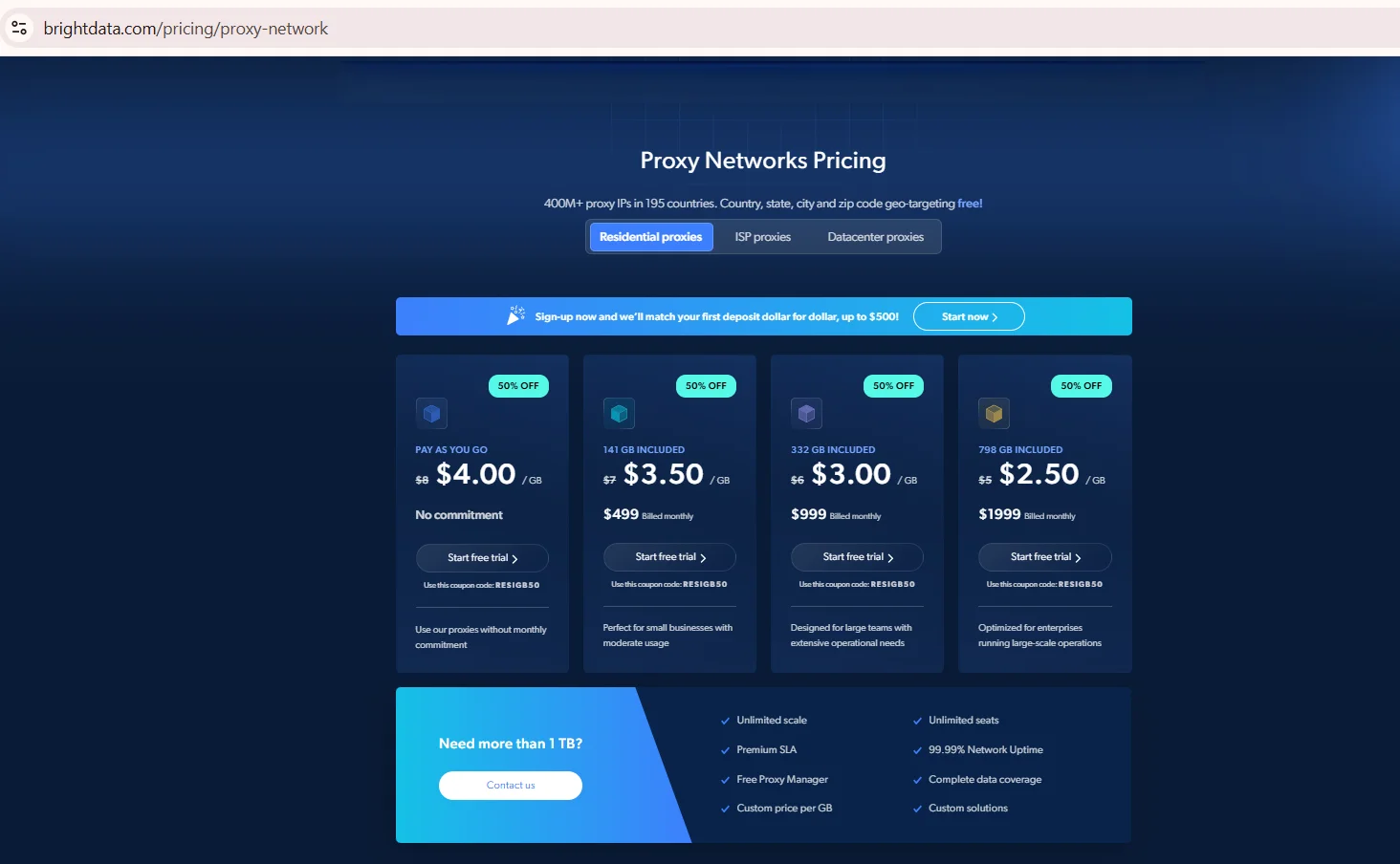
Source: Proxy Networks Pricing, brightdata.com, screenshot taken August 2026
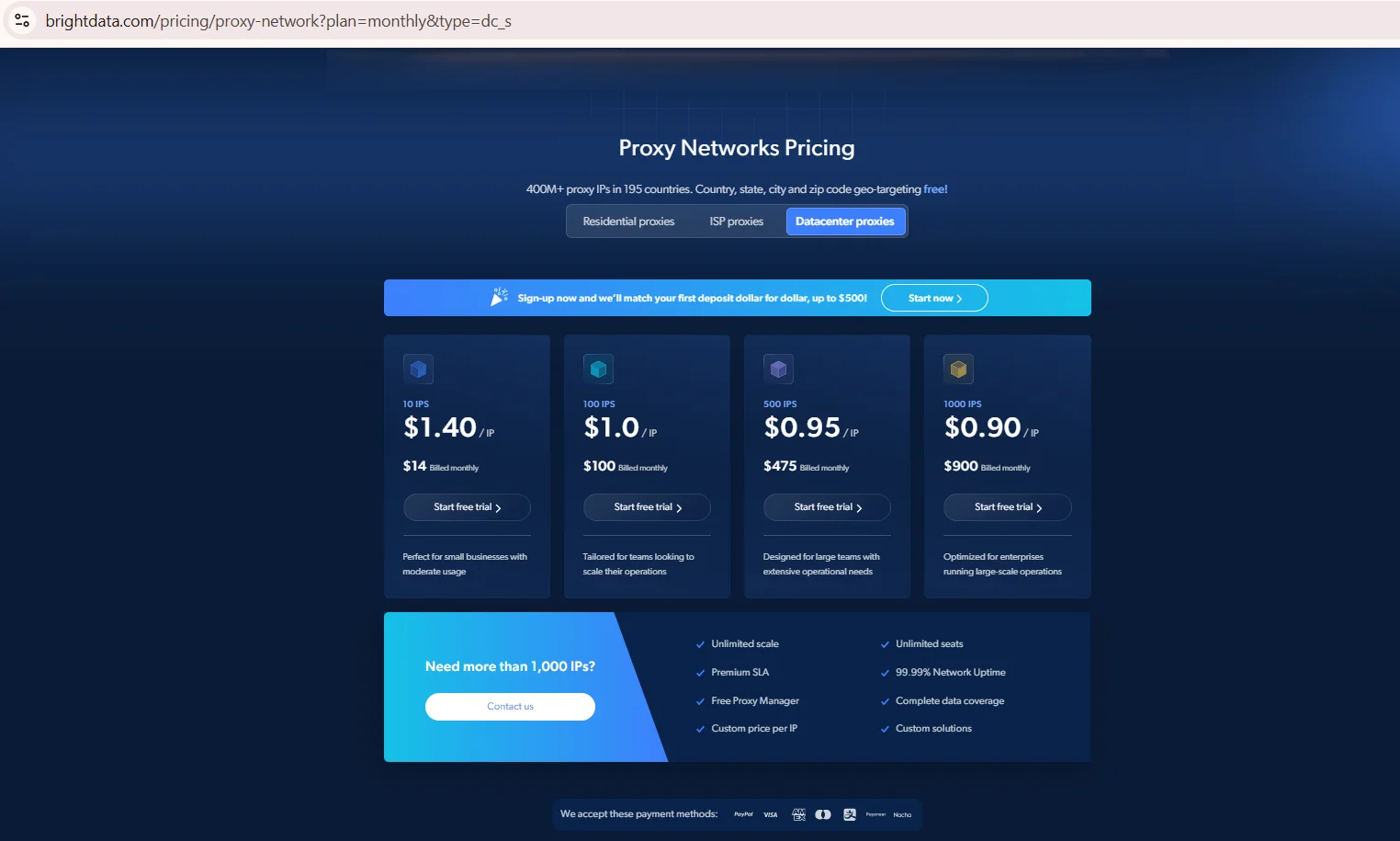
Source: Proxy Networks Pricing, brightdata.com, screenshot taken August 2026
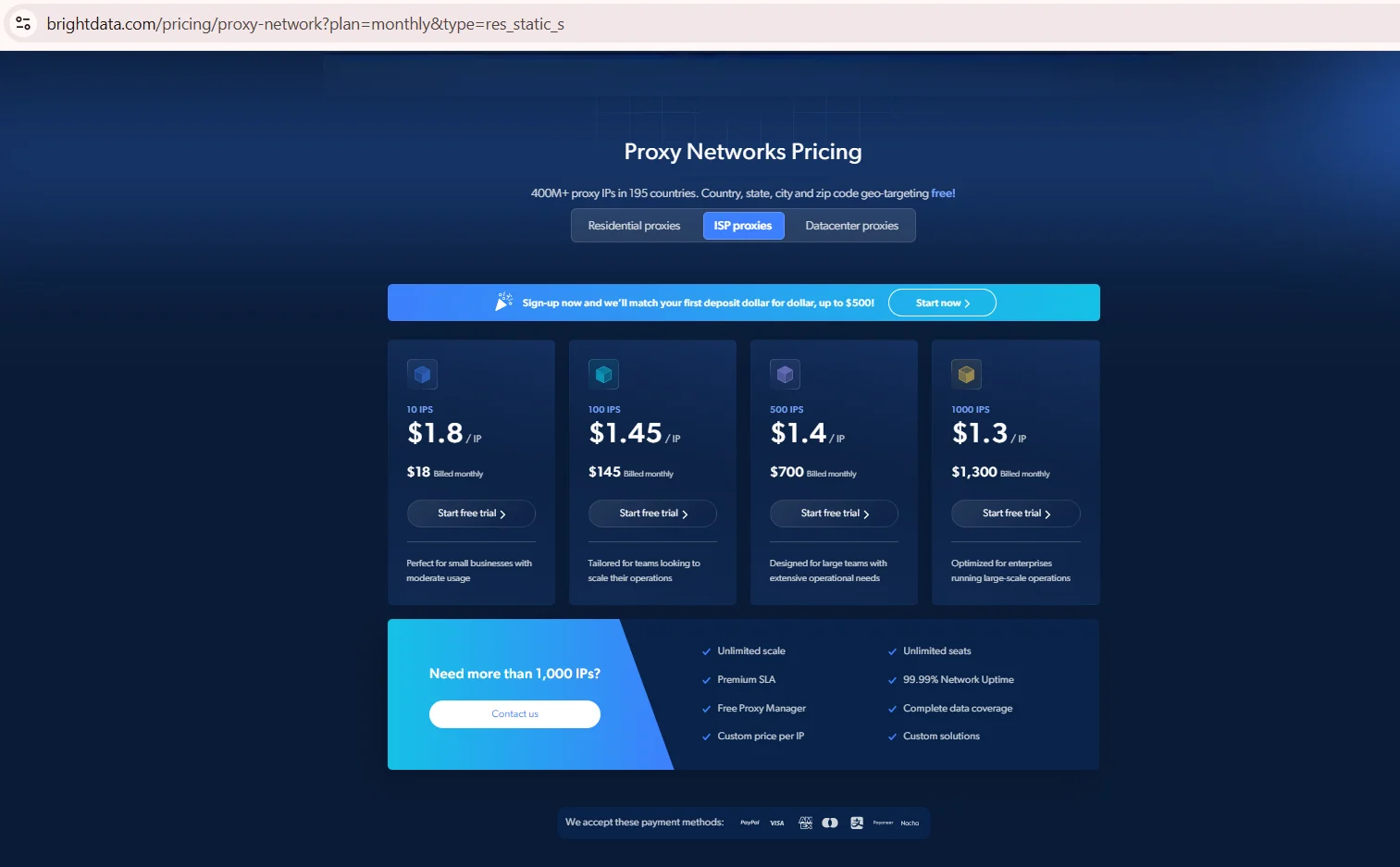
Source: Proxy Networks Pricing, brightdata.com, screenshot taken August 2026
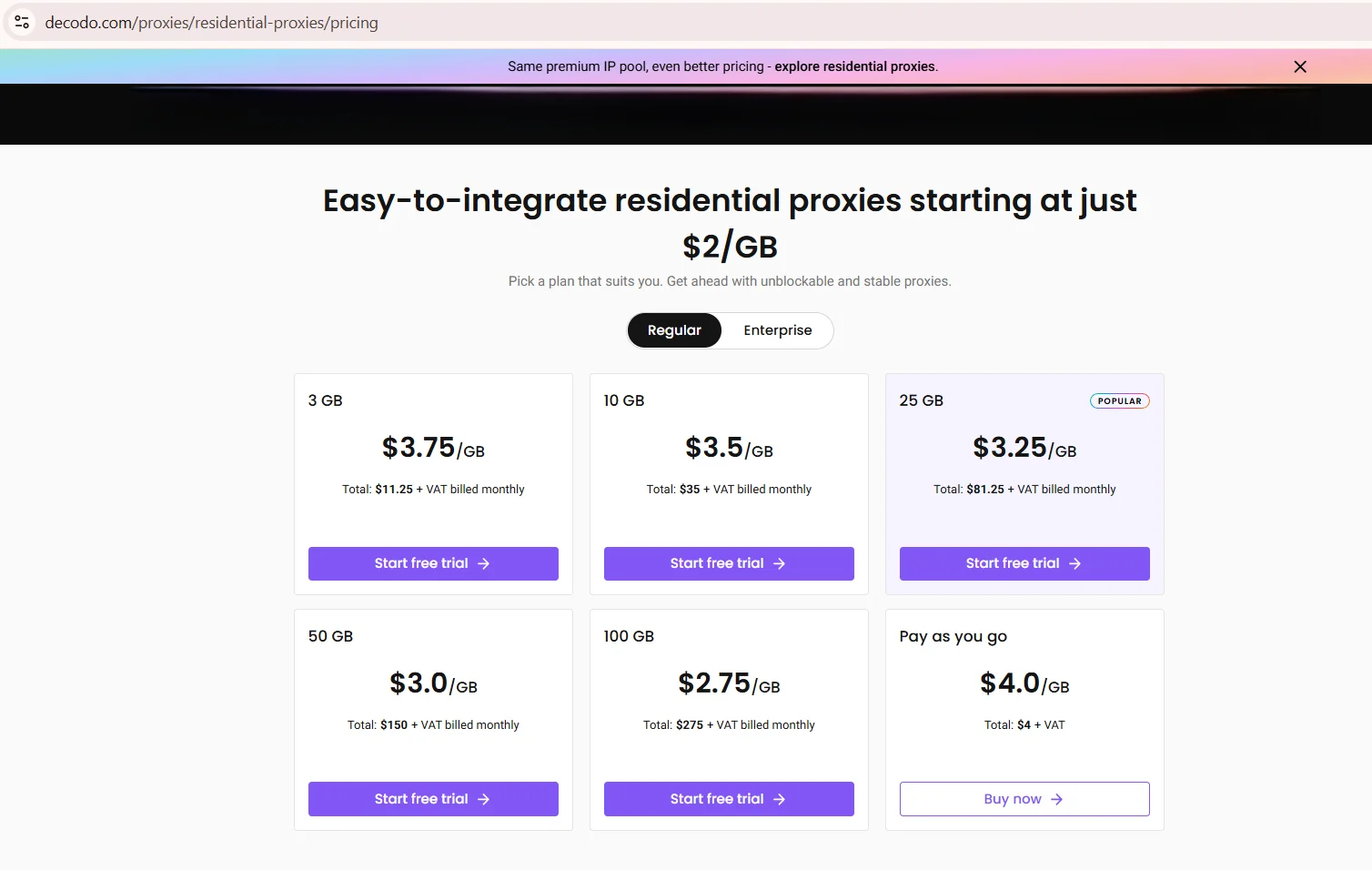
Source: Residential Proxies Pricing, decodo.com, screenshot taken August 2026
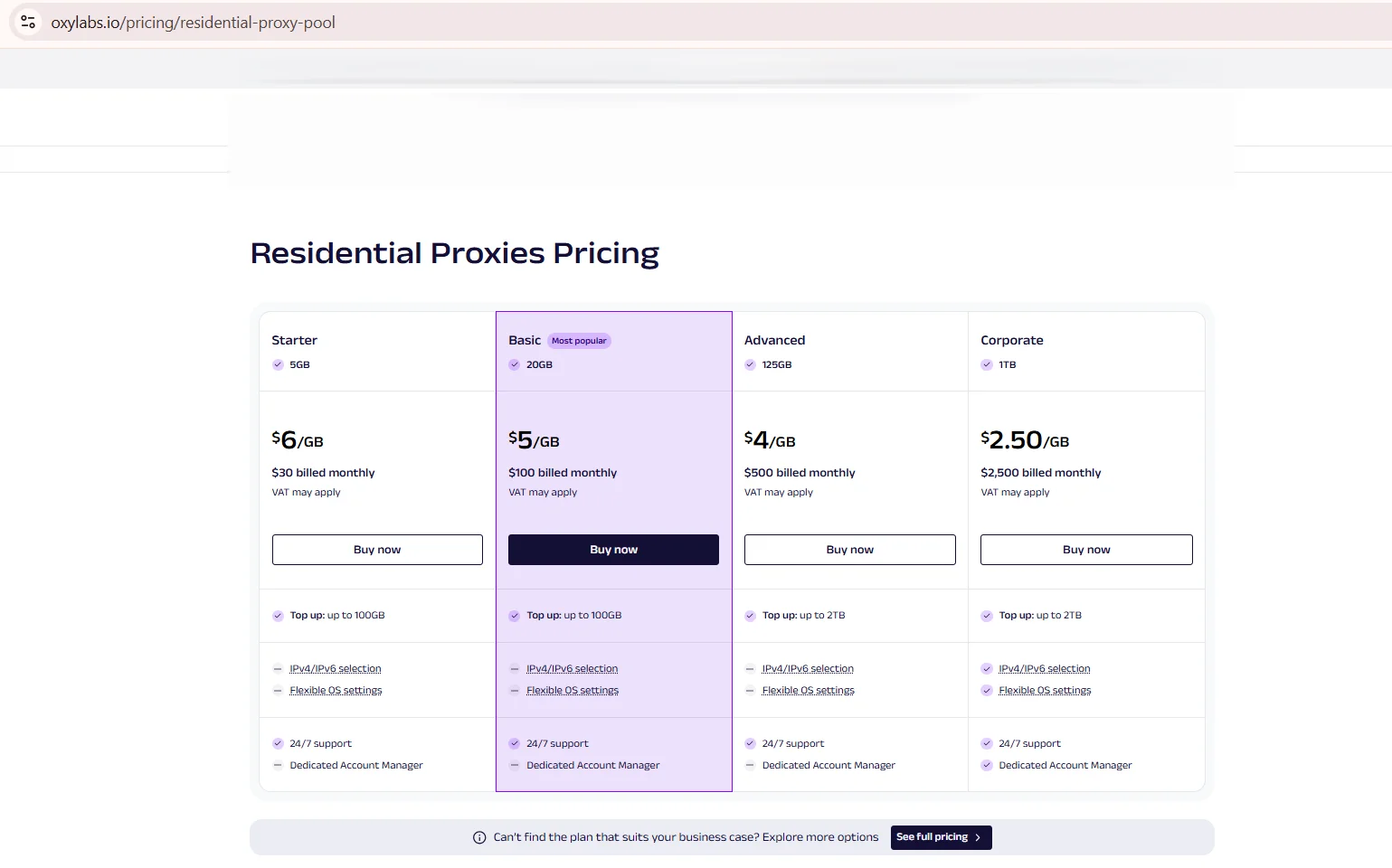
Source: Residential Proxies Pricing, oxylabs.io, screenshot taken August 2026
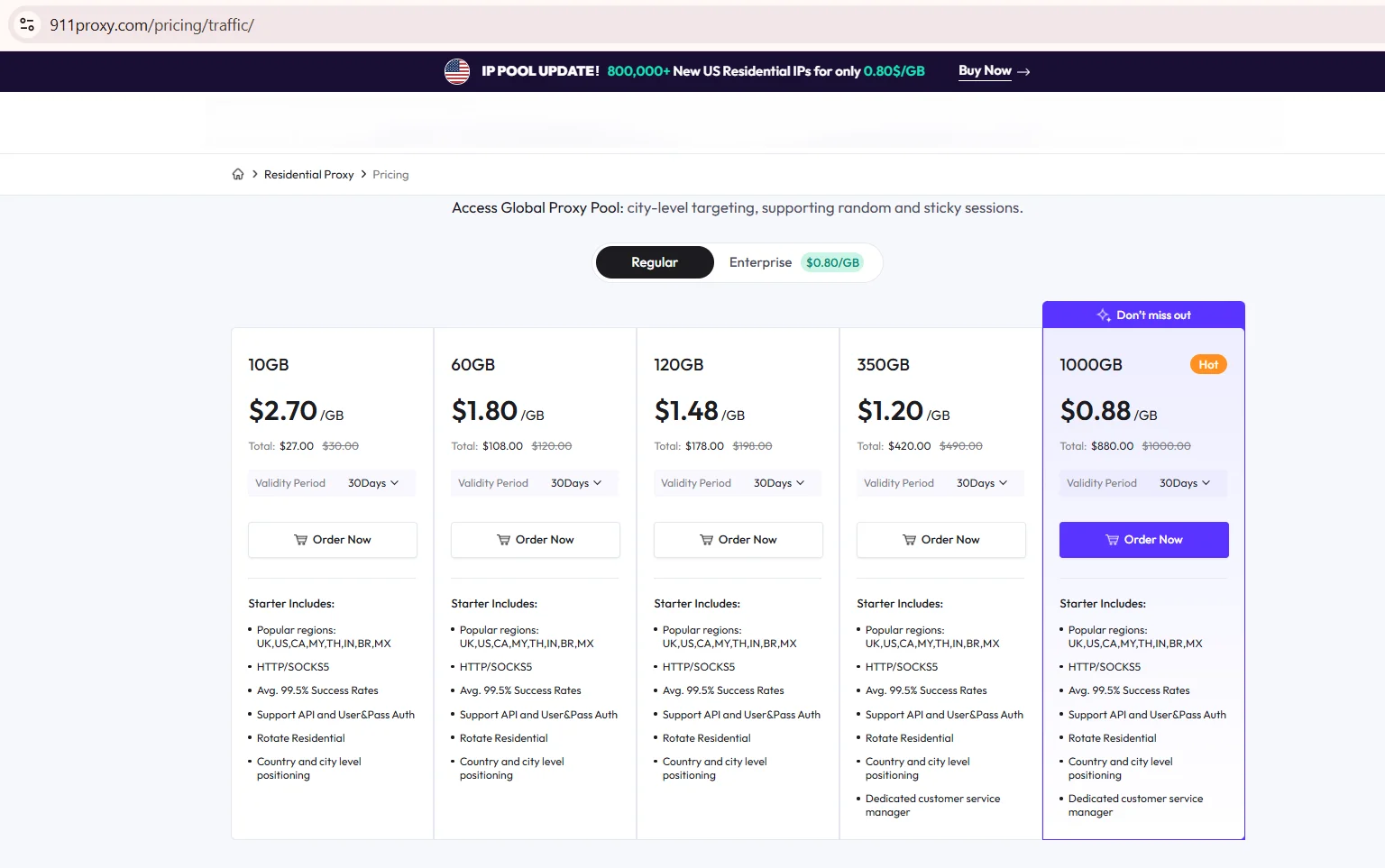
Source: Residential Proxies Pricing, 911proxy.com, screenshot taken August 2026
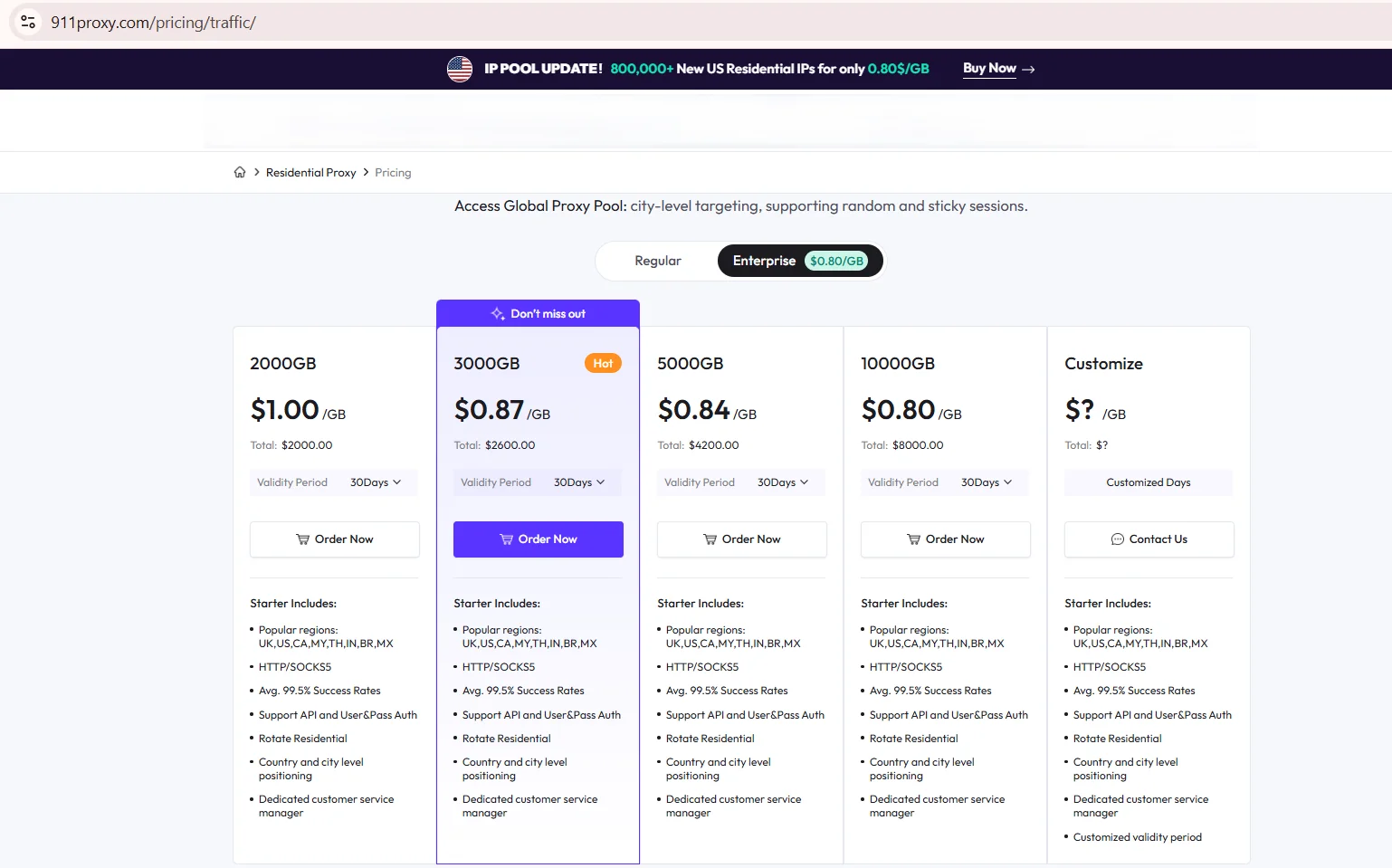
Source: Residential Proxies Pricing, 911proxy.com, screenshot taken August 2026
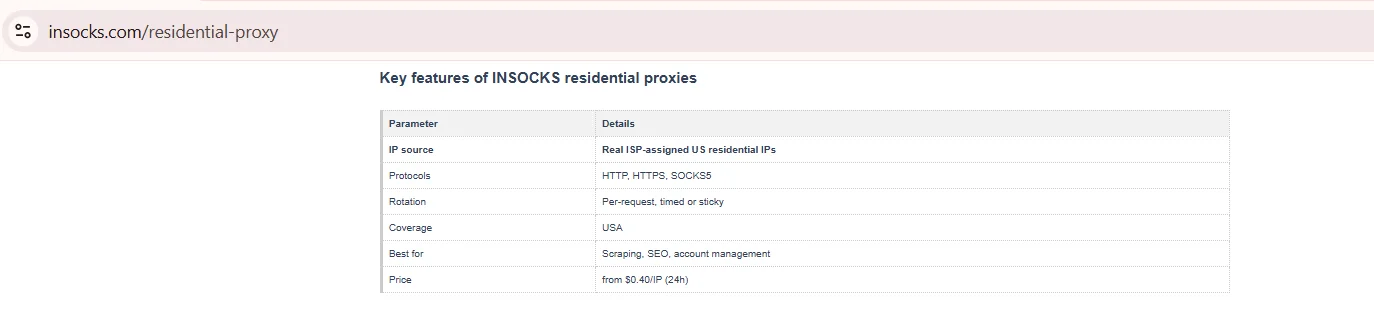
Source: Key features of INSOCKS residential proxies, insocks.com, screenshot taken August 2026
Bright Data prices residential proxies on a pay as you go basis at $4.00/GB, down from a $8/GB base under a 50 percent coupon shown on the page, and reaches $2.50/GB on the 798GB plan, itself discounted from $5/GB. Any other Bright Data alternative is worth checking against those two numbers rather than the base rate alone.
Decodo advertises residential from $2/GB in its page headline, while the Regular table on the same page starts at $3.75/GB for 3GB and falls to $2.75/GB at 100GB.
Oxylabs tiers from $6/GB at 5GB down to $2.50/GB at 1TB, and 911Proxy rotating residential plans on the Regular tab scale from $2.70/GB at 10GB down to $0.88/GB at 1000GB, with a separate Enterprise tab reaching $0.80/GB at 10000GB.
Bright Data alternative before committing to a plan. Decodo starts residential at $2/GB, Oxylabs tiers from $6/GB at 5GB down to $2.50/GB at 1TB, and 911Proxy's rotating residential plans scale from $2.70/GB down to $0.88/GB at the top tier.
None of this changes the fact that scope, protocol support and documented UDP handling matter just as much as the headline rate quoted on a pricing page, a pattern that holds across every one of these Bright Data alternatives.
Why teams look for an alternative and how this list was built
The short answer: teams switch because they need a billing unit, protocol or entry threshold that doesn't match their setup, not because a provider is worse. A team billed per GB with unpredictable page sizes may want per-IP billing instead. A team running UDP-based apps needs that documented, not assumed.
That's the honest framing behind why any single Bright Data alternative gets picked over another. The inclusion criterion here was simple: a public price on the vendor's own site, documented protocols, and a residential product in the lineup. That ruled out providers that only quote pricing after a sales call.
It's worth separating the proxy layer from ready-made scraping API platforms before comparing prices. Replacing a scraping api subscription won't touch your cost if you only pay for raw IP access, and swapping SOCKS5 proxy providers won't fix a scraping API bill either.
Protocol support: SOCKS5, HTTP(S) and UDP
HTTP(S) proxies cannot carry UDP traffic by design, the protocol only tunnels TCP requests. SOCKS5 can support UDP through the ASSOCIATE command, but a provider still has to enable and document it. Remote DNS through the proxy, not the client's local resolver, is what actually prevents DNS leaks.
Among SOCKS5 proxy providers, documented UDP support is still the exception rather than the rule. Bright Data, Decodo and Oxylabs list HTTP(S) and SOCKS5 without a published UDP flag. Insocks documents SOCKS5 UDP directly on its product pages.
For real-time apps like gaming or streaming, that single documentation line decides the shortlist faster than any price chart, which is exactly why Bright Data competitors deserve a protocol check before a price check.
Residential, ISP and datacenter products compared
Comparing residential to residential and ISP to ISP, rather than blending categories, avoids the most common mistake when scanning a list of vendors. Below is a rundown pulled from each provider's own product pages, dated August 2026.
- ✅ Residential proxies: Bright Data, Decodo, Oxylabs, 911Proxy, Insocks, all five offer rotating residential pools.
- ✅ ISP proxies and static residential: Bright Data ($1.3 to $1.8/IP), Oxylabs ($1.2/IP), 911Proxy (from $6.90/IP for 30 days), Insocks.
- ✅ Datacenter proxies: Bright Data ($0.9 to $1.4/IP), 911Proxy (from $4.90/IP for 30 days), Insocks.
- ⚠️ Mobile: Decodo and Oxylabs publish mobile pricing pages; Bright Data and 911Proxy list it separately; Insocks includes mobile in its lineup.
A shortlist built only on residential GB pricing misses that ISP and static products are billed differently, and mixing them into one row would misrepresent how these Bright Data competitors actually differ from each other.
Anyone hunting specifically for cheap residential proxies should still run the protocol and scope check above before comparing rates, since a lower headline price on a narrower product line is not automatically the better deal.
Pricing models and how to compare across them
The short version: per-GB, per-IP and per-request are three different cost structures, and Bright Data competitors structure their bills around all three. Comparing raw numbers across them without normalizing to a single workload is not a real comparison. A $2/GB quote and a $6.90/IP quote answer completely different questions about your actual monthly bill.
| Billing model | Unit | What you pay for |
|---|---|---|
| Per GB | Data transferred | Residential and mobile traffic |
| Per IP | Fixed IP for a period | Static, ISP, datacenter access |
| Per request | Successful call | Scraping API output |
Matching a workload to the right row above is the fastest way to rule out mismatched Bright Data alternatives before running any numbers.
How to compare across billing models
Normalize every quote to one scenario, such as 20GB a month or 10 sticky sessions running 8 hours a day. At that volume, Bright Data's pay as you go rate runs about $160/month, while Decodo's $2/GB tier lands near $40/month for the same traffic.
On the per-IP side, 10 static IPs for 30 days runs roughly $69 at 911Proxy's rate. Skip that math on any of these Bright Data alternatives and the price column in the comparison is just noise.
Cost per successful request, not price per GB
The real cost metric for scraping is dollars per successful response, not dollars per gigabyte, because failed requests still consume bandwidth without producing data. Formula: cost per success = (price per GB × GB per request) ÷ success rate.
Say a target page averages 0.5MB per request and a provider bills $4/GB at a 90% success rate. Cost per request is roughly $0.002, but cost per successful response rises to about $0.0022 once failures are folded in.
Run that formula against your own page weight before ranking any Bright Data alternative by sticker price alone, since a cheap quote with a low success rate can end up costing more per usable result.
How to migrate and run a fair provider test
A fair provider migration test starts before any code changes. Document current usage and spend, then run every shortlisted vendor through the checklist below. Skipping this step is why migrations often get judged on a rushed trial.
- Audit current usage by proxy type, protocol and monthly spend.
- Open a test account with the shortlisted BrightData alternatives and run 200+ requests per target.
- Measure latency as p50 and p95, and log sticky session stability at 10, 30 and 60 minutes.
- Cross-check geo targeting claims against an independent IP geolocation service.
- Compare normalized monthly cost against measured success rates.
- Swap credentials in staging, then roll production traffic gradually.
Steps 2 and 3 form the actual test: without a 200-request floor and both latency percentiles, a short trial tells you little about real volume performance.
Common mistakes when switching providers
Switching between Bright Data alternatives fails for process reasons more often than technical ones, and the list below focuses on the process side rather than repeating the pricing math above.
- ❌ Comparing a per-GB quote against a per-IP quote without normalizing to one workload.
- ❌ Skipping a UDP or SOCKS5 documentation check before real-time use cases.
- ❌ Testing with fewer than 200 requests, then judging reliability from that sample.
- ❌ Rolling 100% of production traffic over on day one, not staged.
- ❌ Trusting a self-reported success rate without an independent geo check.
Where Insocks fits
Disclosure: Insocks is our service. It's included here because it meets the same bar as the other BrightData alternatives above: a public price, documented protocols and a residential line. Insocks also documents SOCKS5 UDP directly, less common in the rest of this comparison.
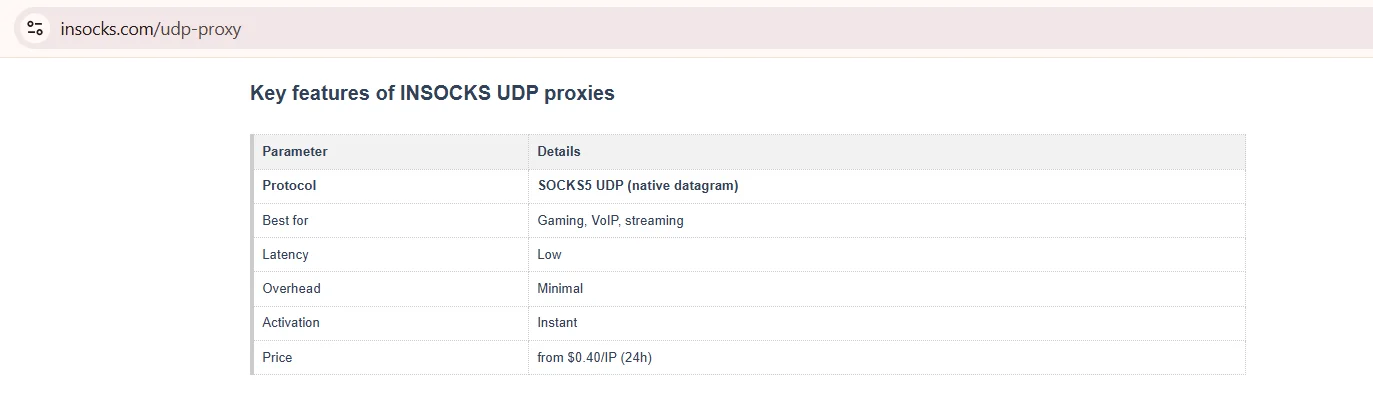
Source: Key features of INSOCKS UDP proxies, insocks.com, screenshot taken August 2026
| Feature | What it means in practice |
|---|---|
| SOCKS5 UDP | Documented support for real-time traffic |
| Per-IP billing | Fixed cost, no surprise bandwidth charges |
| Residential, mobile, ISP, static | Four product lines, one account and API |
| Instant activation | API access within minutes of signup |
| Free demo | Test IP quality before paying |
Using proxies from Insocks or any other provider means confirming your use case stays within each target site's terms of service, a baseline every one of these Bright Data alternatives should meet. In the US, proxies are lawful to use for lawful data collection and testing; this is general information, not legal advice.
Key takeaways
A few numbers matter more than the rest here, summarized below without repeating every table.
- Five providers made this list on published pricing: Bright Data, Decodo, Oxylabs, 911Proxy and Insocks.
- SOCKS5 does not guarantee UDP support, check the documentation, not the protocol name.
- Normalize pricing to one workload before comparing per-GB, per-IP and per-request billing.
- Cost per successful request drives the decision more than price per GB among Bright Data alternatives.
- A fair migration test needs 200+ requests, p50/p95 latency, and an independent geo check.
Disclosure and data sources
All data in this article, including prices, tariff tiers, limits and product availability, is accurate as of the publication date shown on this page. Vendor terms change frequently and without notice, entry tiers move with volume, and promotional pricing may apply on the day you read this. Nothing here is an offer, a guarantee of current terms, or a recommendation to buy.
This article is published by Insocks. Insocks is one of the services listed and we have a commercial interest in it. We are not affiliated with any other provider mentioned; none of them sponsored or reviewed this article. Third-party data was taken from the providers' own pages in August 2026 and may be promotional. All trademarks belong to their respective owners and are used for identification only.
Frequently asked questions
What types of Bright Data alternatives exist?
Three categories: per-GB pool providers, per-IP static providers, and scraping API platforms that bundle proxies with parsing.
Do I need a proxy provider or a scraping API?
A proxy provider if you already run your own scraper; a scraping API if you want parsing and retries handled for you.
How do I compare providers with different billing units?
Normalize every quote to one workload, like 20GB a month, before comparing per-GB, per-IP and per-request rates.
Which alternatives document SOCKS5 with UDP support?
Check each vendor's own docs; UDP is not guaranteed just because SOCKS5 is listed as supported.
How do I verify a provider pricing claim?
Open the vendor's pricing page and note the date, since promo rates and tiers change often.
Does switching providers require code changes?
Usually just endpoint and credential swaps for proxy-only providers; scraping APIs may need more rework.