
Oxylabs alternatives: what to compare before you switch
This guide compares five providers, Oxylabs plus four Oxylabs alternatives, picked because each publishes a public price, documents its protocols, and lists residential proxies in its lineup. The table below covers proxy types, protocol support, billing units and entry pricing, pulled from official pricing pages as of August 2026.
Legend used in every table below: ✅ documented by the vendor · ❌ not offered or not documented · ⚠️ documented with limits · 💡 practical tip. No other marks are used on this page.
Oxylabs alternatives compared
Five providers made the cut: Oxylabs, Bright Data, Decodo, IPRoyal and Insocks. Each publishes residential proxy pricing directly, documents HTTP(S) and SOCKS5 support, and skips the sales call just to see a number. The table lines up proxy types, protocol support, targeting, billing unit and entry price, sourced from vendor pricing pages in August 2026. Treat every figure as a snapshot, not a permanent quote, and use the table to shortlist Oxylabs alternatives for a specific workload.
| Provider | Proxy types | Protocols & UDP | Targeting | Billing unit | Entry price (tier, promo/list) |
|---|---|---|---|---|---|
| Oxylabs | Residential, ISP, Datacenter, Mobile | HTTP(S), SOCKS5, HTTP3; UDP not documented | Country, city, state, ASN | Per GB (residential), per IP (ISP) | $6/GB at 5 GB, list price |
| Bright Data | Residential, ISP, Datacenter, Mobile | HTTP(S), SOCKS5 via Proxy Manager; UDP not documented | Country, city, ASN, ZIP | Per GB | $4/GB pay as you go, promo (list $8/GB) |
| Decodo | Residential, ISP, Datacenter, Mobile | HTTP(S), SOCKS5; UDP not documented | Country, city, state, ZIP, ASN | Per GB (residential), per IP (ISP) | $3.75/GB at 3 GB, list price |
| IPRoyal | Residential, ISP, Datacenter, Mobile | HTTP(S), SOCKS5; UDP not documented | Country, state, city | Per GB (residential), per IP (datacenter) | $7.00/GB at 1 GB on the Subscription tab, 5% off already applied |
| Insocks | Residential, ISP, Static, Mobile, UDP | HTTP(S), SOCKS5, SOCKS5 UDP ✅ documented | Not published as per-tier detail | Per IP, per 24 hours | from $0.40/IP per 24h, rates stated as dynamic |
Two of the five prices above are not plain list rates. IPRoyal shows $7.00/GB on a Subscription tab that already carries a 5 percent discount, with a separate Pay As You Go tab priced differently, and Bright Data shows $4.00/GB under a coupon against a struck-out $8/GB. Insocks states on its own page that rates are dynamic and depend on proxy type and location. Read every figure here as a snapshot taken on the date shown, not a fixed price list.
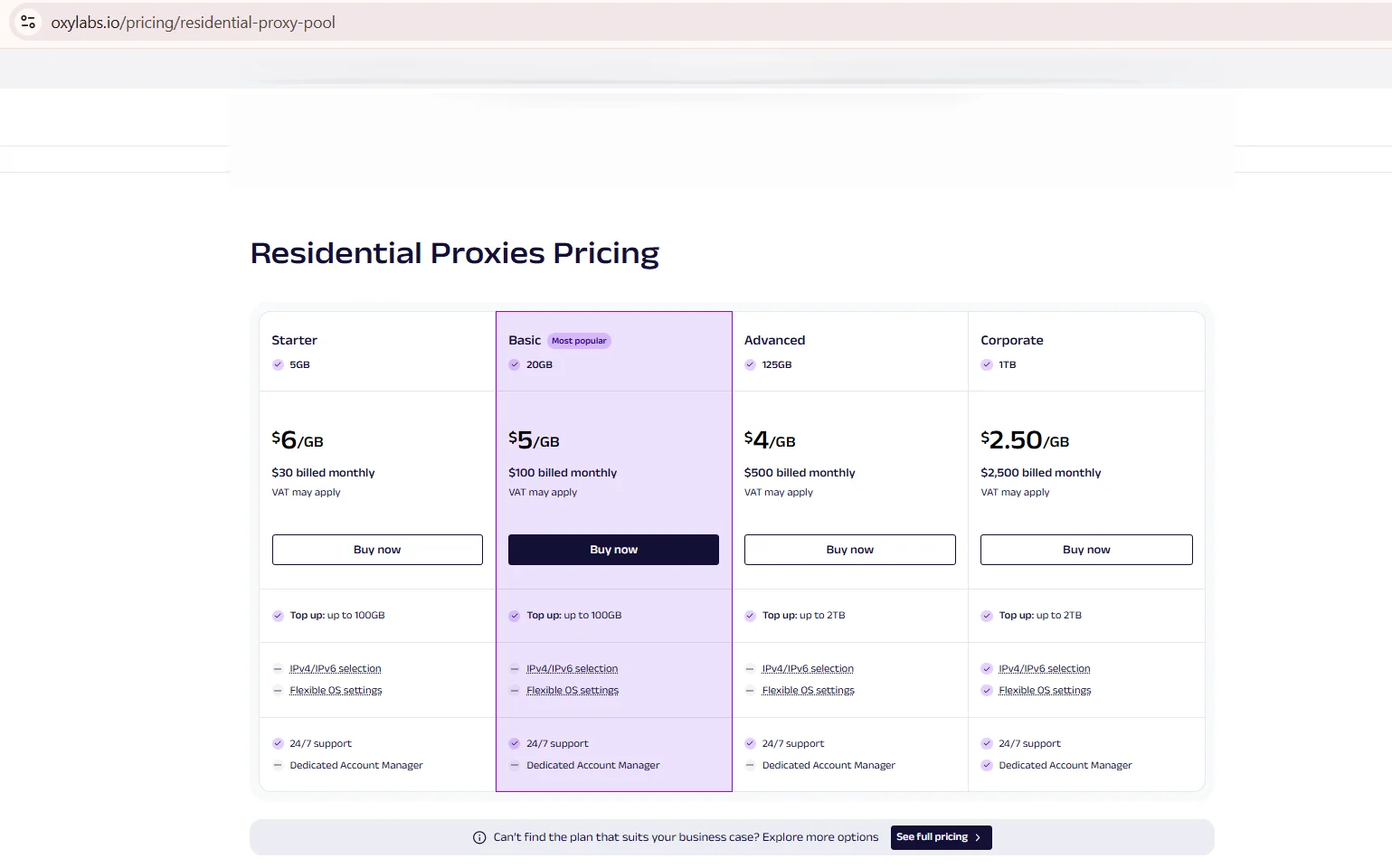
Source: Residential Proxies Pricing, oxylabs.io, screenshot taken August 2026
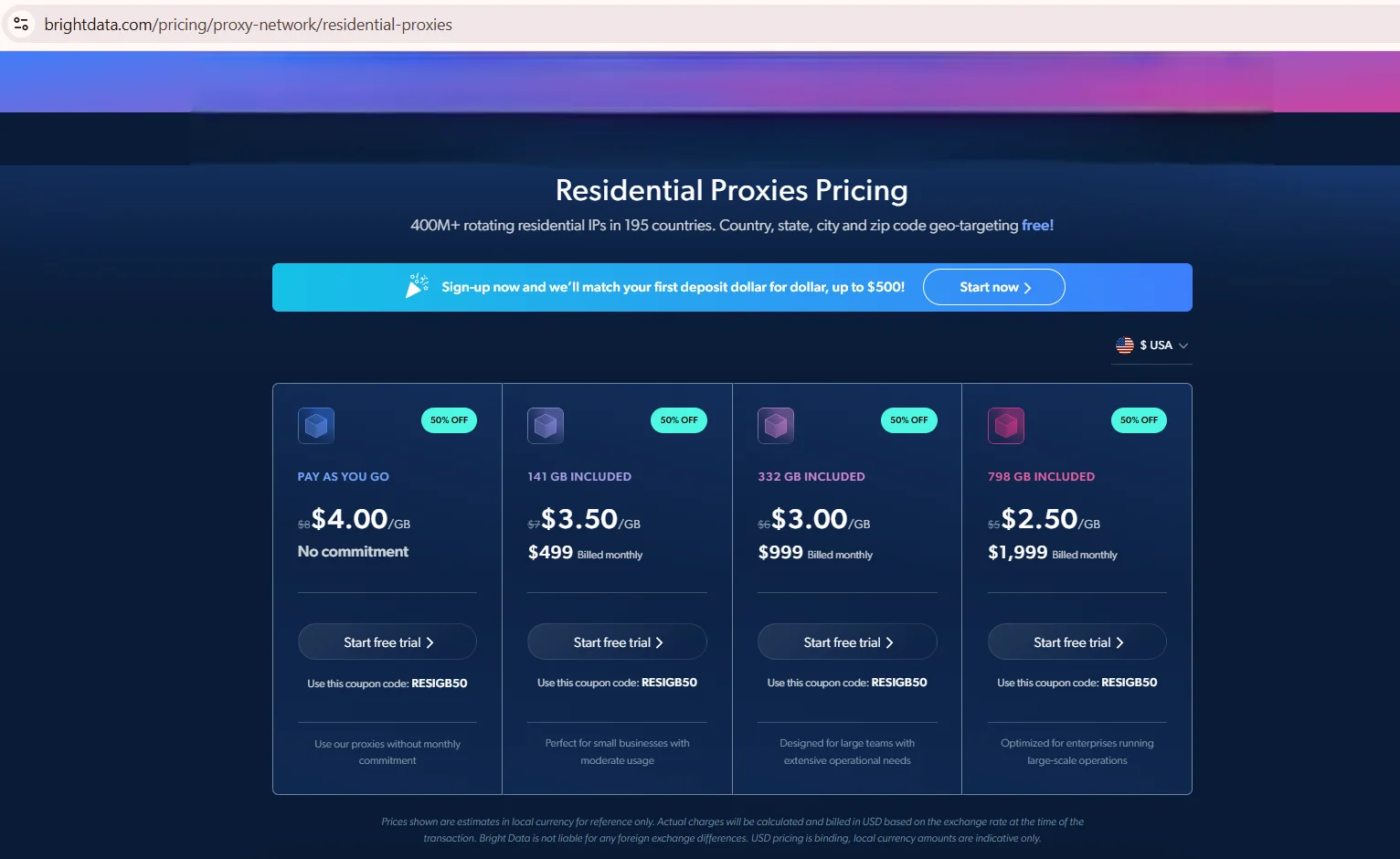
Source: Residential Proxies Pricing, brightdata.com, screenshot taken August 2026
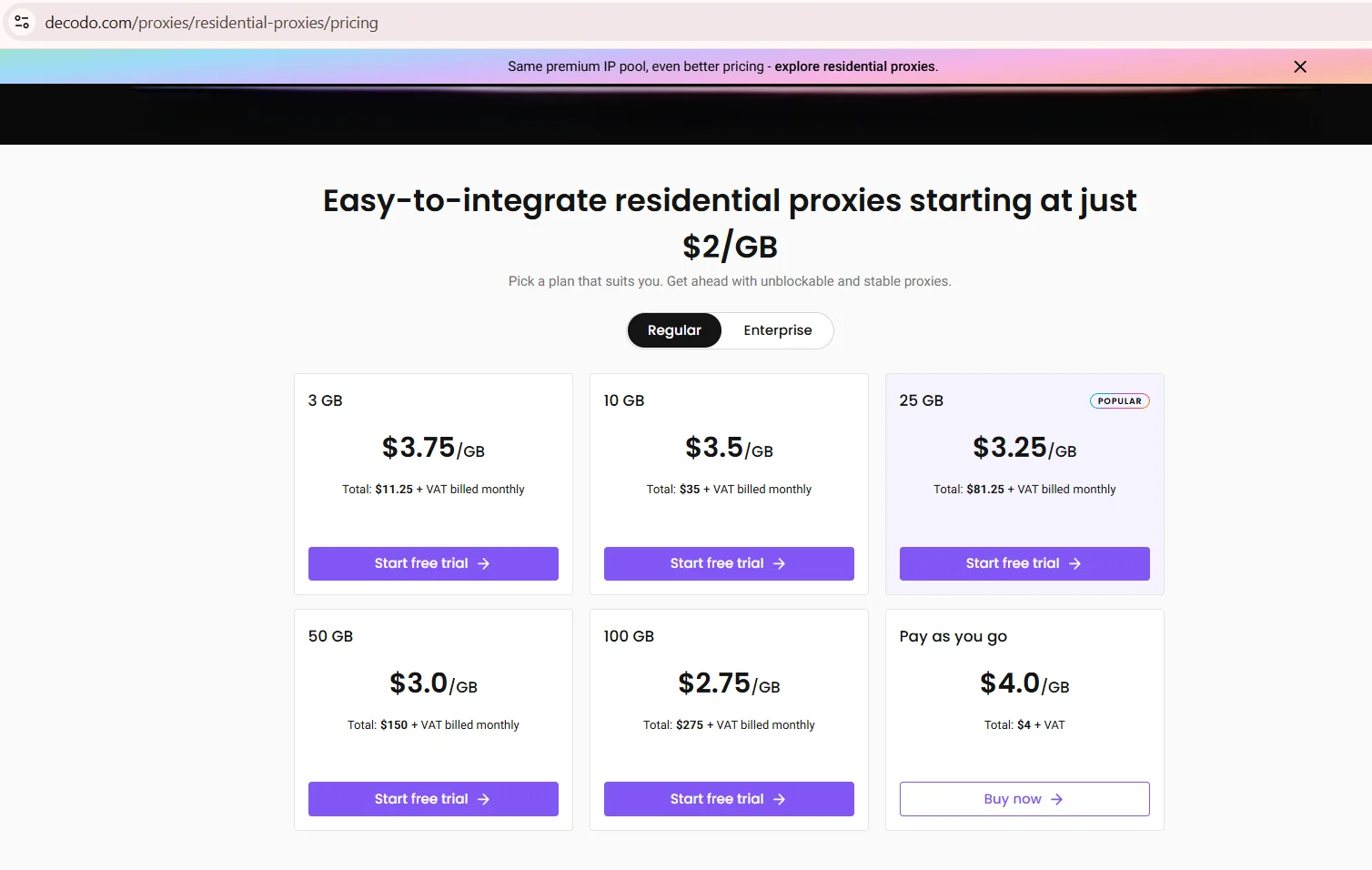
Source: Residential Proxy Pricing, decodo.com, screenshot taken August 2026
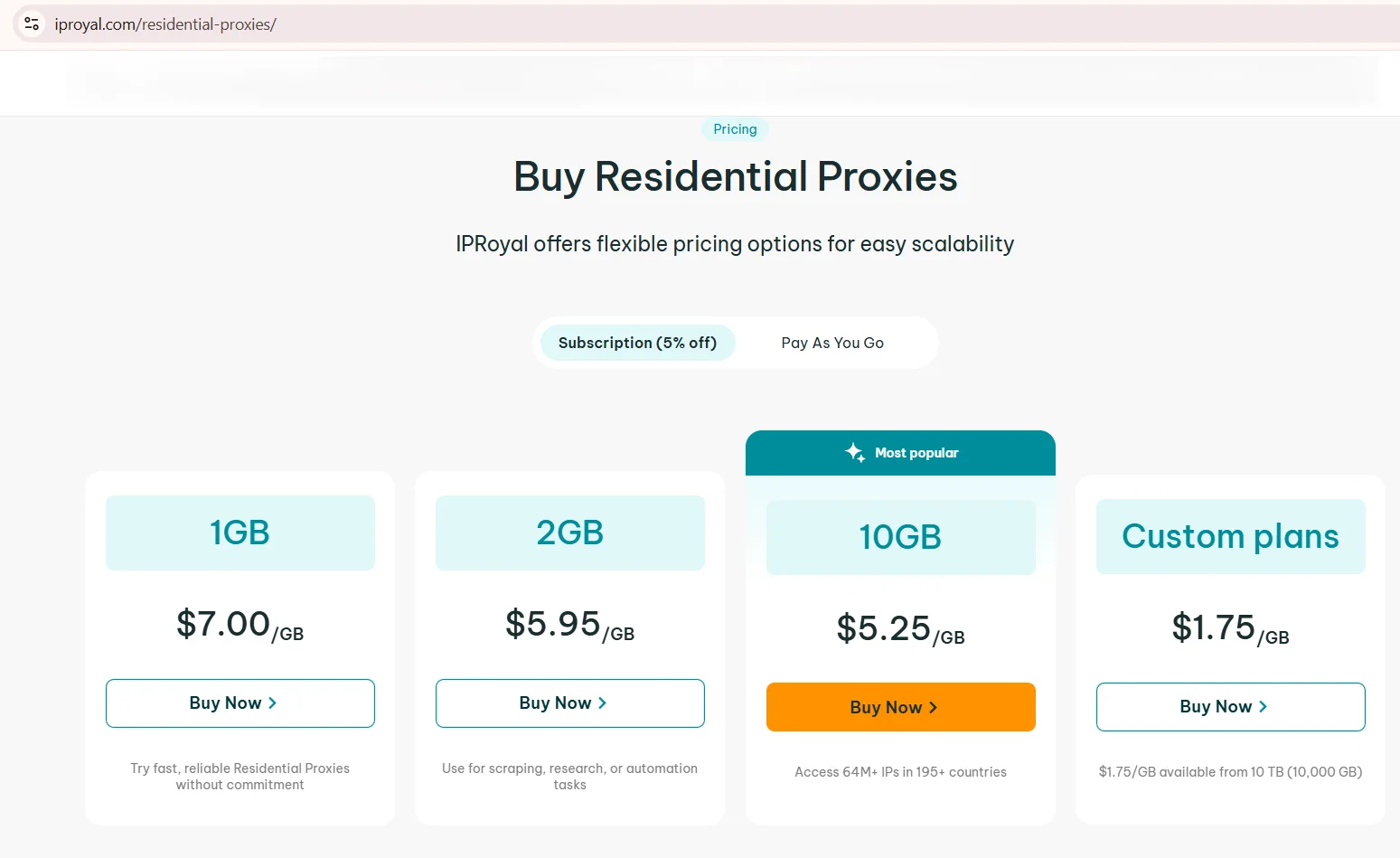
Source: Residential Proxies, iproyal.com, screenshot taken August 2026
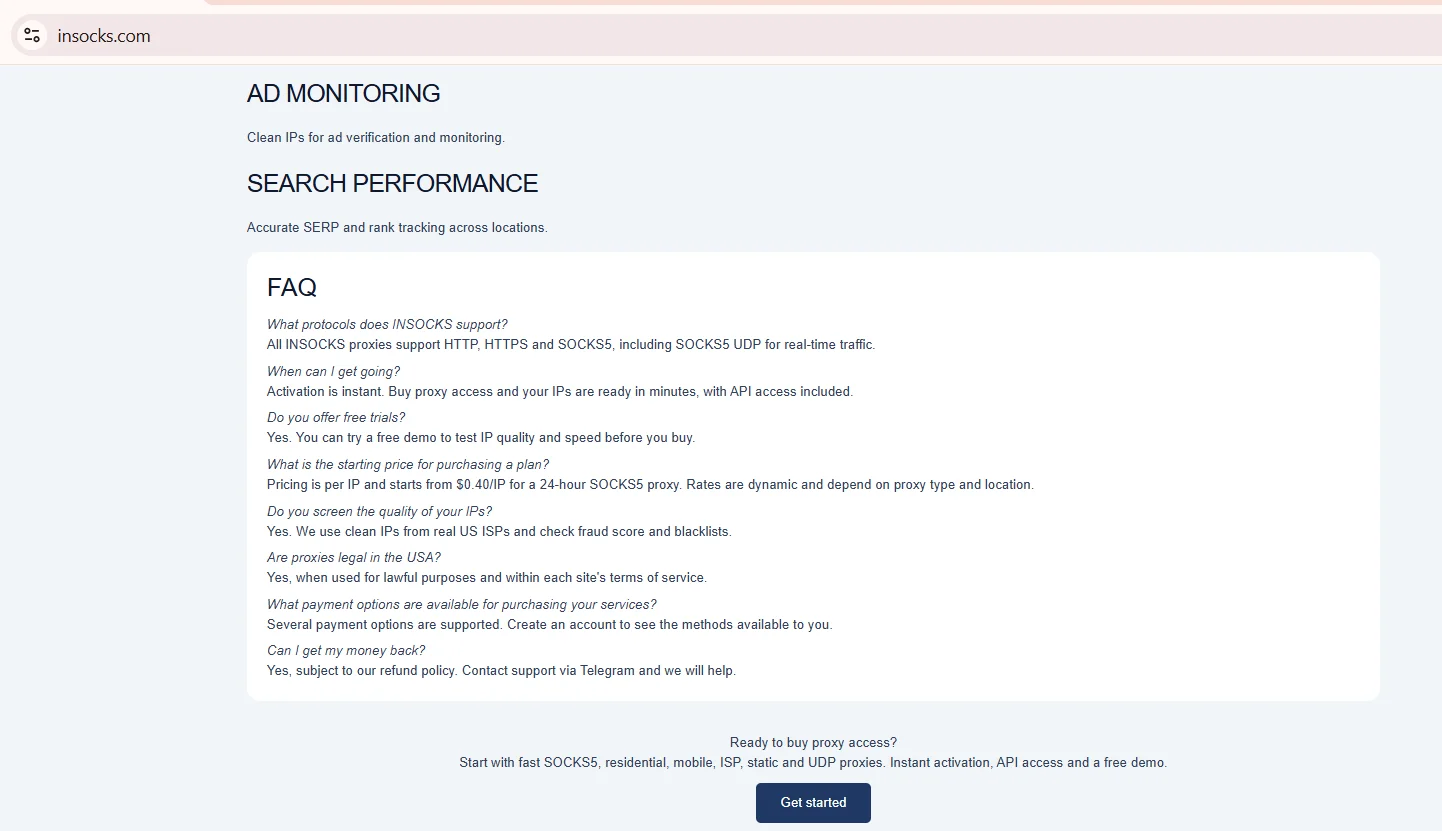
Source: FAQ block, insocks.com, screenshot taken August 2026
Why teams look for an alternative and how this list was built
Teams look for an Oxylabs alternative for concrete reasons: a lower entry threshold, a billing unit that fits their workload, or documented UDP support. None of these are complaints, just different product requirements. The five providers above were picked with three filters: a public price, documented protocol support, and a residential proxy product in the lineup. Providers without a public price page didn't make the list.
- ✅ A lower entry threshold than a $6/GB starter tier
- ✅ Billing per IP or per session instead of per GB
- ✅ Documented SOCKS5 UDP support for real-time traffic
- ✅ A free demo before entering payment details
These four requirements shaped the selection more than brand recognition did, and any single one of them can be a valid reason on its own to test an Oxylabs alternative before renewing a contract.
Protocol support: SOCKS5, HTTP(S) and UDP
HTTP(S) handles most scraping and browsing, but it can't carry UDP traffic at all, that's where SOCKS5 with UDP ASSOCIATE comes in for gaming, VoIP or real-time apps. Whether a provider supports UDP has to come from documentation, not homepage copy, since "SOCKS5 support" often just means TCP-only SOCKS5. Insocks documents SOCKS5 UDP on its dedicated UDP proxy page. Oxylabs, Bright Data, Decodo and IPRoyal document HTTP(S) and SOCKS5, but none list UDP for residential or ISP proxies as of August 2026.
Among SOCKS5 proxy providers here, the split is simple: four offer SOCKS5 over TCP, one adds documented UDP on top. 💡 Confirm UDP support in writing for real-time use cases, a documentation screenshot beats a sales chat transcript. Protocol documentation narrows a list of Oxylabs alternatives fast, before any test traffic runs.
Residential, ISP and datacenter products compared
Residential proxies route through real ISP-assigned IPs and rotate, ISP proxies keep a static IP with ISP-level trust, and datacenter proxies run fastest but get flagged more easily. Each fits a different job, not a straight upgrade from the last. Comparing them means keeping categories separate, residential against residential, ISP against ISP, never mixed, the same discipline that matters when reading an Oxylabs pricing page across several proxy types at once. The list below follows that rule.
Residential proxy providers here, Oxylabs, Bright Data, Decodo, IPRoyal and Insocks, all route through real ISP-assigned addresses and rotate by default. ISP proxy providers here, Oxylabs, Bright Data, Decodo and IPRoyal, sell dedicated or shared static IPs billed by the IP; Insocks lists an ISP product but doesn't publish per-tier pricing. Datacenter proxies appear in every lineup except Insocks', worth checking directly before ruling any of these Oxylabs alternatives out for a datacenter-heavy project.
Pricing models and how to compare across them
Billing here isn't uniform: residential proxies are billed per GB, ISP proxies per IP monthly on some of these vendors, and Insocks per IP per 24 hours, so raw prices mean little without normalizing to one scenario first. 💡 A $4/GB rate and a $0.40/IP daily rate aren't competing numbers until both map onto the same workload. The table shows what each billing unit charges for, a distinction most Oxylabs competitors leave out of their headline rate.
| Billing model | Unit | What you pay for |
|---|---|---|
| Per GB | Gigabyte of traffic | Data transferred through rotating IPs |
| Per IP, monthly | Dedicated or shared IP | Access to one static address for a billing cycle |
| Per IP, 24 hours | Single IP for one day | A short-lived address, renewed manually or automatically |
How to compare across billing models
Normalize every offer to one scenario, for example 20 GB a month or 10 sticky sessions running 8 hours a day, then compute the real cost per vendor. For per-GB vendors, multiply the entry rate by the volume. For per-IP vendors, estimate how many IPs and renewals a comparable workload needs across a month. This turns four billing units into one comparable number, the same math worth running before comparing quotes from any two Oxylabs competitors, not after the first invoice arrives.
How to migrate and run a like-for-like test
A fair test between two candidate providers uses the same sites, volume, geography and time window for both, anything less turns results into noise. The steps below make that repeatable, worth running before signing a contract with any new vendor.
- Define the test. Pick one target site category, at least 200 requests per provider, and one time window.
- Run both providers in parallel. Route identical requests through each candidate during the same hours, so a target-side spike doesn't skew one provider's numbers.
- Measure latency as p50 and p95. Averages hide tail latency, and p95 usually breaks a time-sensitive job.
- Test sticky sessions at 10, 30 and 60 minutes. Stability tends to diverge past the 30-minute mark.
- Verify geo-targeting independently. Cross-check the location with a separate IP geolocation service, not the vendor's own dashboard.
Five steps take a day or two per candidate, short next to the cost of picking the wrong one among several Oxylabs competitors.
Common mistakes when comparing providers
Most comparison mistakes happen before the first test request is sent. A rushed evaluation compares numbers never meant to sit side by side. The five points below cover errors seen most often among residential proxy providers and ISP proxy providers shortlists. None require fixing the provider, just the method, and that holds for a shortlist of two or a dozen Oxylabs alternatives.
- ❌ Comparing per-GB pricing directly against per-IP pricing without normalizing to one scenario
- ❌ Testing only during business hours and assuming latency holds at night
- ❌ Trusting a vendor's own success rate without an independent geo or uptime check
- ❌ Skipping kyc verification, then hitting a bandwidth cap mid-project
- ❌ Judging a provider off one sticky session length instead of testing 10, 30 and 60 minutes
Where Insocks fits
Disclosure: Insocks is our service. Insocks focuses on the SOCKS5 use case with documented UDP support, a feature not listed on the public pricing pages of the other four providers compared here. It bills per IP for 24 hours rather than per GB, which suits short scraping bursts better than long bandwidth-heavy jobs. A free demo is available before any payment details, across residential, mobile, ISP, static and UDP products. Against a bandwidth-based Oxylabs alternative, per-IP billing and documented UDP are the two differences worth testing directly.
| Feature | What it means in practice |
|---|---|
| SOCKS5 UDP ✅ | Real-time traffic like gaming or VoIP can route through the same proxy as HTTP(S) |
| Per-IP, 24h billing | Cost scales with IPs used, not data volume, useful for short bursts |
| Free demo | IPs can be tested before entering payment details |
| US ISP sourcing | IPs come from real US internet service providers |
Teams weighing this against other Oxylabs alternatives can try the demo or register for full access before committing to a plan.
Key takeaways
- ✅ Five providers made this list because each publishes a public price and documents its protocols.
- ✅ Billing units differ sharply: per GB, per IP monthly and per IP daily aren't directly comparable without normalizing first.
- ✅ SOCKS5 UDP support isn't universal, check documentation, not homepage copy.
- ✅ A fair test needs matched volume, geography and time window, plus p50/p95 latency and an independent geo check.
- ✅ Insocks bills per IP per 24 hours and documents UDP, a different shape than typical bandwidth-based proxy vendors.
Disclosure and data sources
All data in this article, including prices, tariff tiers, limits and product availability, is accurate as of the publication date shown on this page. Vendor terms change frequently and without notice, entry tiers move with volume, and promotional pricing may apply on the day you read this. Nothing here is an offer, a guarantee of current terms, or a recommendation to buy.
This article is published by Insocks. Insocks is one of the services listed and we have a commercial interest in it. We are not affiliated with any other provider mentioned; none sponsored or reviewed this article. Third-party data was taken from the providers' own pages in August 2026 and may be promotional. Oxylabs pricing figures came from Oxylabs' own pricing pages rather than a review aggregator, and every other pricing point listed followed the same sourcing rule. All trademarks belong to their respective owners, used for identification only. Using any provider listed here means confirming that use stays within current US law and each target site's terms of service.
Frequently asked questions
These are the questions readers ask most often when comparing Oxylabs alternatives before switching providers. Answers stay short and factual, without ranking brands or subjective claims. Always check a provider's own pricing page before committing to a plan.
What types of Oxylabs alternatives exist?
Categories include residential, ISP, datacenter, mobile and SOCKS5 proxy services, each suited to a different traffic pattern.
How do I compare providers like for like?
Match proxy type, protocol, volume, geography and time window, then compare only providers within the same category.
How do I compare plans with different billing units?
Normalize every plan to one scenario, such as 20 GB a month, then calculate the total cost of that scenario per vendor.
Which alternatives document SOCKS5 with UDP support?
Check each vendor's own documentation page directly; UDP support is rarely listed in homepage marketing copy.
What test volume is enough to compare two providers?
At least 200 requests per provider, run within the same time window, gives a workable first signal.
How do I verify a provider pricing claim?
Open the official pricing page directly and check the date, the volume tier, and whether the number is promo or list price.