
SOCKS5 proxy provider comparison: what to look at
A SOCKS5 proxy provider routes TCP and UDP traffic at the session layer, without touching HTTP headers, unlike a plain HTTP proxy. This comparison checks six providers against Insocks on three criteria: pricing, documented SOCKS5 support and published port rules.
Legend used in every table below: ✅ documented by the vendor · ❌ not offered or not documented · ⚠️ documented with limits · 💡 practical tip. No other marks are used on this page.
This lineup covers seven SOCKS5 proxy providers, Insocks included, filtered through one simple rule:
- ✅ pricing is published on the provider's own site
- ✅ SOCKS5 support is documented, not just claimed in ad copy
- ✅ port and UDP rules are written somewhere a buyer can read
A marketing line saying SOCKS5 is supported and a documented UDP ASSOCIATE command are two separate claims, so the table below treats them as two rows. Pool type, documented SOCKS5 support and port rules come from each provider’s own pricing page or help center. The UDP column is different: most vendors publish nothing about UDP ASSOCIATE, so those cells cite an independent hands-on benchmark by AIMultiple, marked as such in every row where it applies. AIMultiple discloses that several of the tested vendors subscribe to its benchmarking services, so treat those cells as third-party test results rather than vendor documentation.
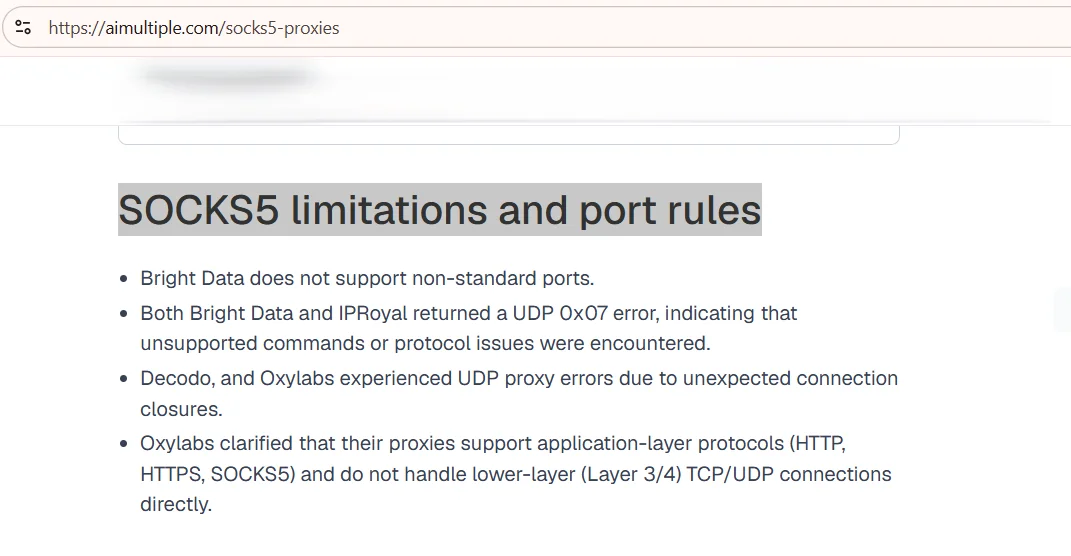
Source: SOCKS5 limitations and port rules, aimultiple.com, screenshot taken August 2026
What a SOCKS5 proxy actually does
A SOCKS5 proxy relays any TCP or UDP session between a client and a target server without reading the payload, working the same for a browser, a game client or a custom script. Under the SOCKS5 protocol it sits at the session layer, one level below HTTP, and doesn't inspect content, so it isn't a VPN.
The SOCKS5 vs http proxy question comes down to traffic type. HTTP proxies only forward HTTP and HTTPS requests, while SOCKS5 forwards whatever the app sends, UDP included. 💡 That's why it shows up in gaming and VoIP stacks that need more than a plain web request.
Authentication rides on the handshake itself: a client connects with no auth, with username password auth, or through GSS-API, and ip whitelisting can stand in for a login entirely on the server side.
SOCKS5 providers compared
The table below lines up SOCKS5 proxy providers next to Insocks using five columns: pool type, documented SOCKS5 support, documented UDP ASSOCIATE and port restrictions. Data as of August 2026. Cells marked per AIMultiple come from that independent benchmark, everything else from the vendors’ own pages.
| Provider | Pool type | SOCKS5 documented | UDP ASSOCIATE | Port restrictions |
|---|---|---|---|---|
| Bright Data | Residential, ISP, DC, mobile | ✅ | ⚠️ limited, per AIMultiple | ⚠️ non-standard ports |
| Oxylabs | ISP, dedicated DC | ✅ | ❌ app-layer only | ⚠️ 80/443 open by default |
| Webshare | Residential, DC, ISP | ✅ | Not documented | Not documented |
| Decodo | Residential, mobile, ISP, DC | ✅ | ⚠️ UDP errors, per AIMultiple | ✅ 80, 443, plus extra |
| Rayobyte | Dedicated DC, ISP | ✅ | Not documented | Not documented |
| IPRoyal | Residential, DC, ISP, mobile | ✅ | ⚠️ UDP 0x07 error, per AIMultiple | ⚠️ some domains restricted |
| Insocks | Residential, mobile, static, ISP | ✅ | ✅ dedicated UDP proxy product | Not documented |
Two things are worth knowing before you use this table. Most vendors publish nothing at all about UDP ASSOCIATE, so that column leans on an independent benchmark, and that benchmark discloses commercial ties to several of the vendors it ranks. A cell reading Not documented means the provider does not state the parameter on its own pages, which is not the same as saying the feature is missing, so confirm it directly before you buy.
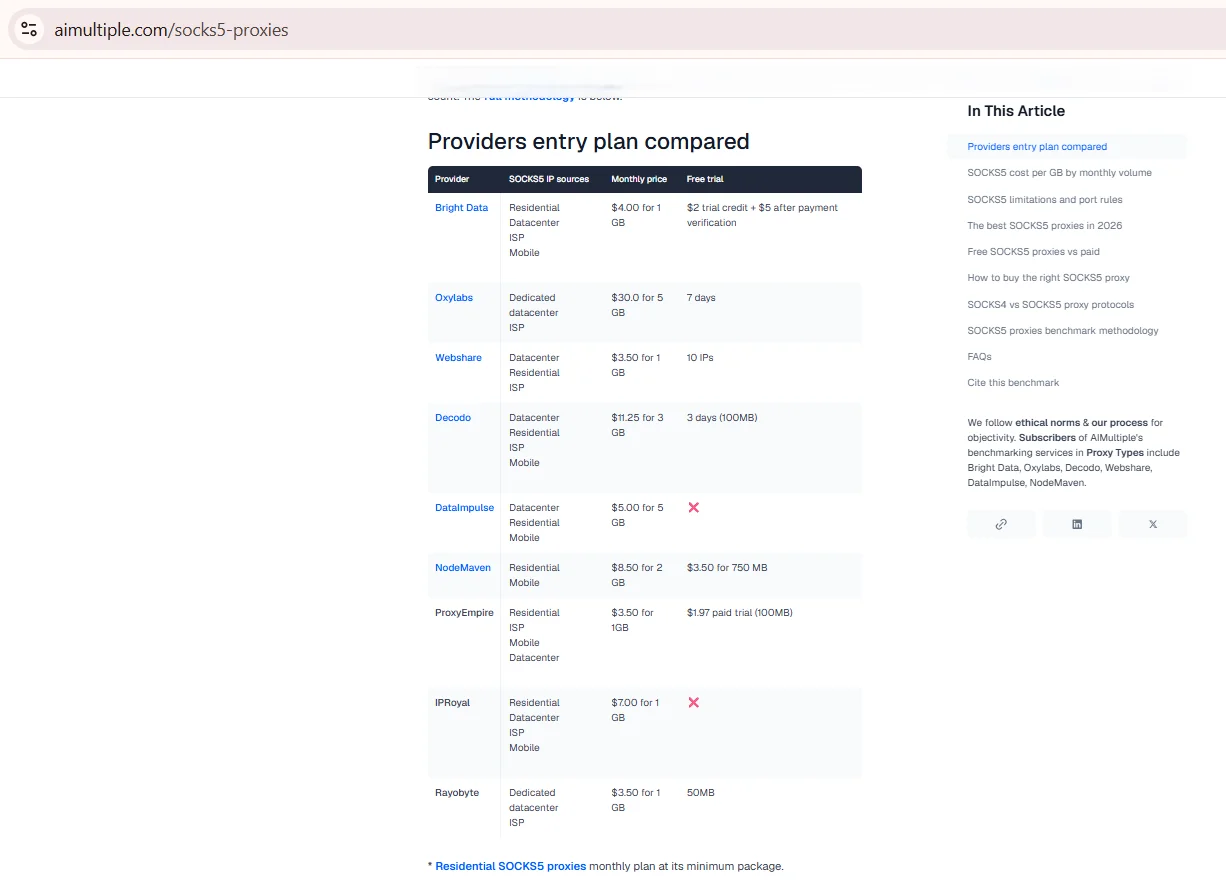
Source: Providers entry plan compared, aimultiple.com, screenshot taken August 2026
The same benchmark also lists entry plans, useful for a rough sense of scale rather than a price comparison: Bright Data at $4.00 for 1 GB, Webshare and Rayobyte at $3.50 for 1 GB, IPRoyal at $7.00 for 1 GB, Decodo at $11.25 for 3 GB and Oxylabs at $30.00 for 5 GB, all as of the check date. Insocks bills per IP instead, from $0.40 per IP for a 24-hour SOCKS5 proxy, so the two models only line up after normalizing to one workload.
This isn't a complete SOCKS5 proxy list of the whole market, just six names plus Insocks against the criteria above. Anyone building a shortlist should apply the same rule and check the docs, not the homepage banner.
Why SOCKS5 matters for non-HTTP traffic
A chunk of real internet traffic isn't HTTP at all: DNS lookups, QUIC and HTTP/3 handshakes, game packets and custom protocols run over UDP or raw TCP. An HTTP proxy simply can't carry that kind of session.
✅ Legitimate use cases:
- QA and load testing of an app's own UDP or TCP endpoints
- Collecting publicly available data within a site's own terms
- Checking how a service behaves for users in a given country
- Running real-time apps like VoIP through a stable route
Anyone who wants to buy SOCKS5 proxy access should stay inside the target platform's own rules and current US law, sticking to lawful, terms-compliant work rather than ban evasion or fake accounts.
SOCKS5 on residential, ISP and datacenter pools
The pool behind a SOCKS5 proxy changes how it looks to a target server, even though the protocol stays the same. A SOCKS5 residential proxy uses an IP from a home ISP, passing fraud checks that flag hosting ranges, while a plain datacenter IP is faster but easier to spot.
- Residential pool: fits reputation-sensitive tasks, slower and pricier per GB
- Datacenter pool: fastest, cheapest, easiest to fingerprint
- ISP pool: stable IP, residential-style ASN, good for long sessions
- Mobile pool: carrier-grade trust, shared IP behind carrier NAT
None of these pool types changes whether UDP ASSOCIATE actually works, that's a separate setting, documented or not.
Authentication, ports and what breaks in practice
SOCKS5 proxy providers split auth into two camps: username password auth sent during the handshake, or ip whitelisting checked against the connecting address instead. The first works from any machine, the second needs a static outbound IP and breaks once it changes.
| Parameter | Why it matters | Where documented |
|---|---|---|
| Auth method | Whether it works from shared or rotating IPs | Connection docs |
| Port restrictions | Some providers close SMTP or odd ports | Limitations page |
| Session limit | Caps parallel connections a script can open | Plan comparison page |
A private SOCKS5 proxy account usually supports both auth methods, and switching between them is a config change rather than a new purchase. Mistakes below apply across nearly every provider, not just one:
- ❌ assuming an HTTP login works on SOCKS5 without checking auth docs
- ❌ hardcoding port 443 when it's restricted for that proxy type
- ❌ running more sessions than a plan allows, then blaming the network
SOCKS5 vs socks5h and remote DNS
Plenty of teams buy SOCKS5 proxy access for exactly this kind of traffic, then get caught out by a DNS leak nobody checked for. SOCKS5h resolves the hostname on the proxy server itself, closing that leak, while plain socks5 lets the client's own resolver look it up first.
In cURL the fix is a single flag:
- curl --socks5-hostname user:pass@host:1080 https://example.com
Python's requests library takes the same scheme swap, socks5h:// instead of socks5://. 💡 Test both against a leak checker before locking a config, since remote dns isn't always the default.
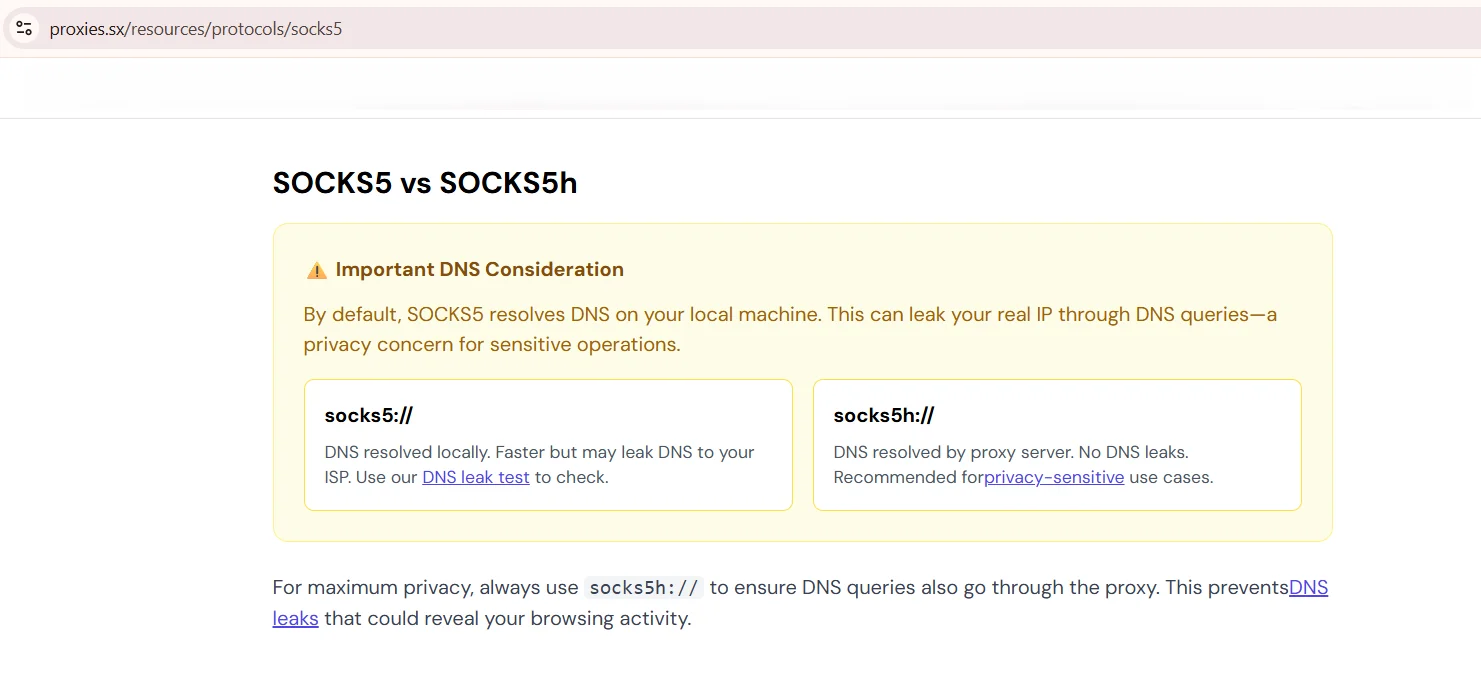
Source: SOCKS5 vs SOCKS5h, proxies.sx, screenshot taken August 2026
Pricing models and how to compare across them
SOCKS5 proxy providers bill in different units, so lining up a per-GB plan against a per-IP plan without a common scenario misleads.
| Billing model | Unit | What to check |
|---|---|---|
| Per-GB bandwidth | $ per GB | Whether the rate drops at higher tiers |
| Per-IP static | $ per IP per day/month | Whether SOCKS5 is included or extra |
| Hybrid | Base fee plus usage | Whether the base fee covers any traffic |
To normalize, pick one scenario, say 10 GB monthly, and price it on every public page. AIMultiple's August 2026 benchmark puts SOCKS5 residential proxy plans at roughly $3.50 to $8.50 per GB, datacenter priced on a different scale.
How to test a SOCKS5 provider in one day
A same-day test costs little and confirms most of what a provider's own docs actually claim, well before signing anything long term. Anyone hunting for the best SOCKS5 proxy for their own workload should run through these checks first.
- Confirm the outbound IP matches the ordered location.
- Send 200+ requests to a real target, log success rate.
- Test UDP ASSOCIATE against a UDP echo service.
- Run a DNS leak test with socks5h on, then off.
- Measure latency as p50 and p95.
- Check geolocation against an independent tool.
A provider that claims to be the best SOCKS5 proxy for a given region should clear all six checks, no excuses.
Common mistakes when buying SOCKS5 proxies
A lot of buyer's remorse in this space traces back to a check that was sitting in the documentation the whole time and simply got skipped over during signup. Before paying for anything, it helps to cross-check a provider's own SOCKS5 proxy list entry against its docs, not a review site's summary of it.
- ❌ Trusting a "SOCKS5 supported" claim without checking UDP docs.
- ❌ Comparing a per-GB residential price to a per-IP datacenter price.
- ❌ Skipping a DNS leak test after switching to socks5h.
- ❌ Assuming port rules match across pool types.
- ❌ Locking into an annual plan before the one-day test above.
How Insocks fits SOCKS5 workloads
Disclosure: Insocks is our service. Among the SOCKS5 proxy providers named earlier, it sits in the residential, mobile, static and ISP segment, with a dedicated UDP proxy line alongside standard SOCKS5.
| Feature | What it means in practice |
|---|---|
| SOCKS5 and UDP proxy | Separate line for real-time, low-latency traffic |
| Instant activation | Access starts right after signup |
| Per-IP billing | From $0.40 per IP for a 24-hour SOCKS5 proxy |
| Free demo | A test allocation for the checks above |
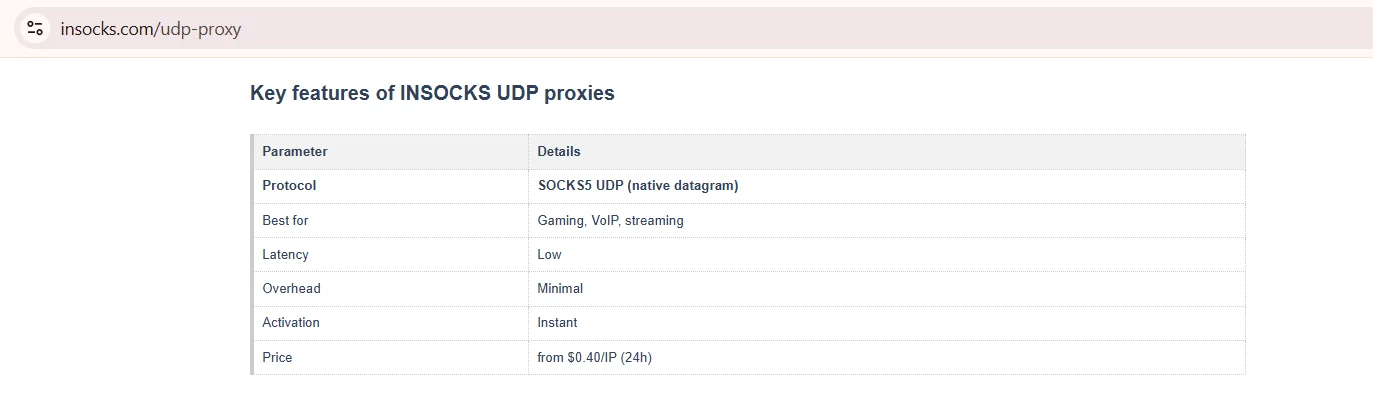
Source: Key features of INSOCKS UDP proxies, insocks.com, screenshot taken August 2026
Anyone who ran their own checks can start from a demo account rather than a full commitment.
Key takeaways
A short recap of the points that matter most from this SOCKS5 proxy providers comparison, skimmable in a few seconds.
- SOCKS5 works at the session layer and carries TCP and UDP, unlike HTTP-only proxies.
- Marketing text and documented UDP ASSOCIATE support are two different claims.
- Pool type changes IP reputation, not protocol behavior.
- Socks5h resolves DNS on the proxy side, closing a leak plain socks5 leaves open.
- A same-day test beats trusting any single provider's claim on its own.
Disclosure and data sources
All data in this article, including prices, tariff tiers, limits and product availability, is accurate as of the publication date shown on this page. Vendor terms change frequently and without notice, entry tiers move with volume, and promotional pricing may apply on the day you read this. Nothing here is an offer, a guarantee of current terms, or a recommendation to buy.
This article is published by Insocks, one of the SOCKS5 proxy providers featured above, and has a commercial interest in it. There is no affiliation with any other provider mentioned; none of them sponsored, reviewed or approved this piece. Third-party data came from the providers' own pages in August 2026 and may be promotional. The UDP column relies on an independent third-party benchmark, which discloses commercial ties to several of the vendors it tested. All product names and trademarks belong to their respective owners and are used for identification only.
Frequently asked questions
These six questions cover the checks buyers ask most before picking a plan. Answers stay short on purpose, the goal is a direct answer, not a full explanation.
Does every SOCKS5 provider support UDP?
No. Some document TCP-only support or report UDP errors in independent testing.
What is the difference between SOCKS5 and socks5h?
Socks5h resolves DNS on the proxy server, plain socks5 resolves it on the client first.
Does SOCKS5 encrypt my traffic?
No, the protocol adds no encryption on its own, only IP masking and session relay.
Which pool type suits SOCKS5 workloads?
Residential and ISP suit reputation-sensitive tasks, datacenter suits speed and cost.
How do I verify a UDP support claim?
Run a UDP ASSOCIATE test against an echo service instead of trusting marketing copy.
Why do some providers block certain ports?
To limit spam and abuse, common blocks include SMTP ports like 25, 465 and 587.