
Streaming availability monitoring across regions
Streaming availability monitoring is the regular check of which titles, plans and prices a streaming service shows in each country. Media companies, rights holders, analysts and ad teams use it to confirm licensing coverage and spot gaps. The work relies only on public pages: catalog listings, title pages and plan or pricing pages.
What is streaming availability monitoring
It's a scheduled check of whether a title is listed on a platform in a given market and how that listing changes over time. The output is a dated record you can compare month to month, which is far more useful than a single look at a catalog.
- Media companies confirm where their titles are live.
- Rights holders check that a licensing window opened and closed on time.
- Market analysts compare catalog size and depth across countries.
- Ad verification teams match campaigns to where a title is actually available.
Why catalogs differ by country
Catalogs differ because rights are licensed by territory and by period. Each regional catalog reflects the deals a platform holds in that market today.
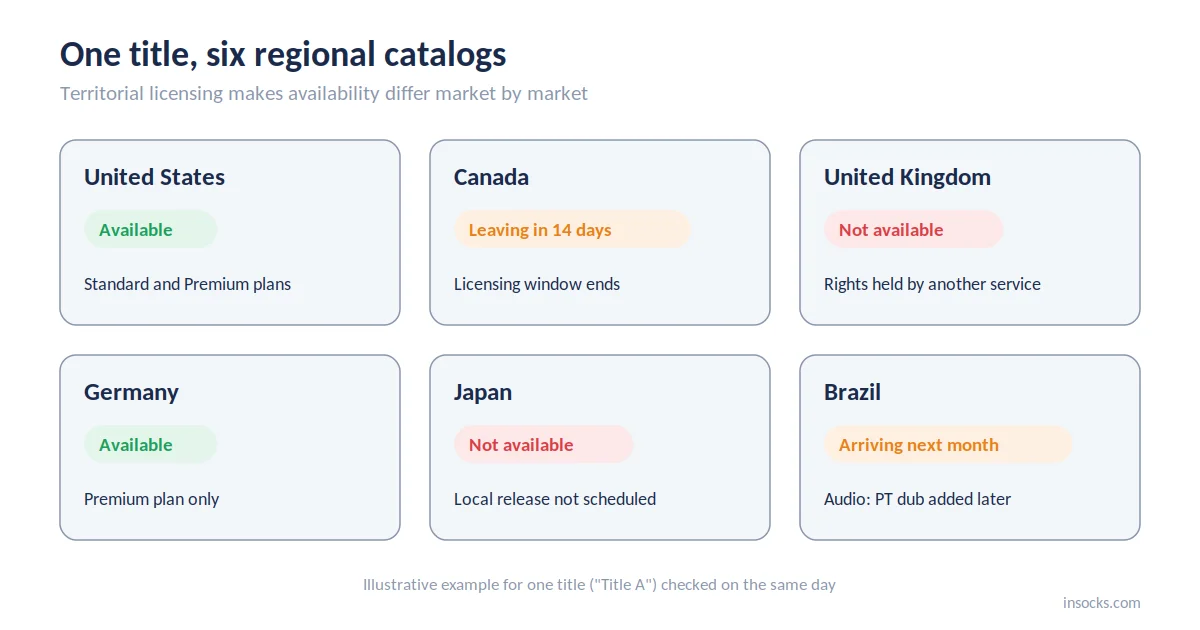
The same title can be live, leaving or missing depending on the market
A licensing window can close in Canada months before it closes in the US, local productions launch on local schedules, and ratings rules change what can be shown. Rights also move at renewal time, so regional content availability shifts every quarter.
💡 Record the date and time of every check. Without them, you can't tell a licensing change from a collection error.
What teams actually track
Content availability monitoring focuses on a short list of fields that answer business questions. Most teams start with presence and dates, then add plans and prices.
| Metric | What it shows |
|---|---|
| Title presence | Whether a title is listed in the market |
| Arrival date | When the title first appeared |
| Removal date | When the title left the catalog |
| Catalog composition | Size and genre mix per market |
| Audio and subtitles | Which languages are offered |
| Plan tiers | Which plan includes the title |
| Local prices | What each plan costs in local currency |
These fields cover most reporting needs. Rights teams read arrival and removal dates, pricing analysts read plans and prices, and ad teams read presence before a campaign goes live.
Which proxy type fits regional monitoring
Residential proxies are the usual choice for routine regional checks, because their IPs geolocate to real consumer areas. Mobile, ISP and datacenter IPs fit narrower tasks. Mobile IPs help when a service shows different offers in its app or mobile site, but they cost more, so keep them for spot checks.
In this context, a streaming proxy is simply a proxy used to view public catalog pages from the right market.
| Type | Trust level | Best for |
|---|---|---|
| Residential | High | Routine checks across many markets |
| Mobile | High | Mobile-first services and app store pages |
| ISP | Medium-high | Long, stable sessions from a fixed IP |
| Datacenter | Low | Internal testing and non-media targets |
A residential proxy with a broad residential IP pool covers most markets, while an ISP proxy suits long daily runs from one address.
Why datacenter IPs often fail on media platforms
Datacenter IPs often return generic or partial pages on media platforms. Their ASN belongs to a hosting company, and many services treat hosting ranges differently from home and mobile networks.
- ✅ Residential and mobile IPs geolocate to real consumer areas.
- ✅ ISP IPs pair stable uptime with consumer-network registration.
- ❌ Hosting ASNs often receive a generic or limited page.
- ❌ Datacenter geolocation can be off by a region or even a country.
For a monitoring team, both issues mean the same thing: data that doesn't reflect the market. Keep datacenter IPs for internal tests of your own pipeline, where speed matters and geolocation doesn't.
How to build a regional monitoring workflow step by step
A repeatable streaming availability monitoring workflow turns single checks into data you can compare over months. Build it once, then run it on a fixed schedule.
- Pick markets. Start from the business question rather than every available country.
- Set vantage points. Assign one or more locations per market, with city level targeting where offers vary.
- Fix request parameters. Lock language, device type and headers for each market.
- Collect public catalog pages. Pull listing, title and pricing pages on schedule.
- Normalize the data. Map titles to stable IDs and store every field in one format.
- Keep history. Save each result with a timestamp and vantage point for data validation later.
Most teams automate steps 4 to 6 and review steps 1 to 3 each quarter, when licensing deals and priority markets change.
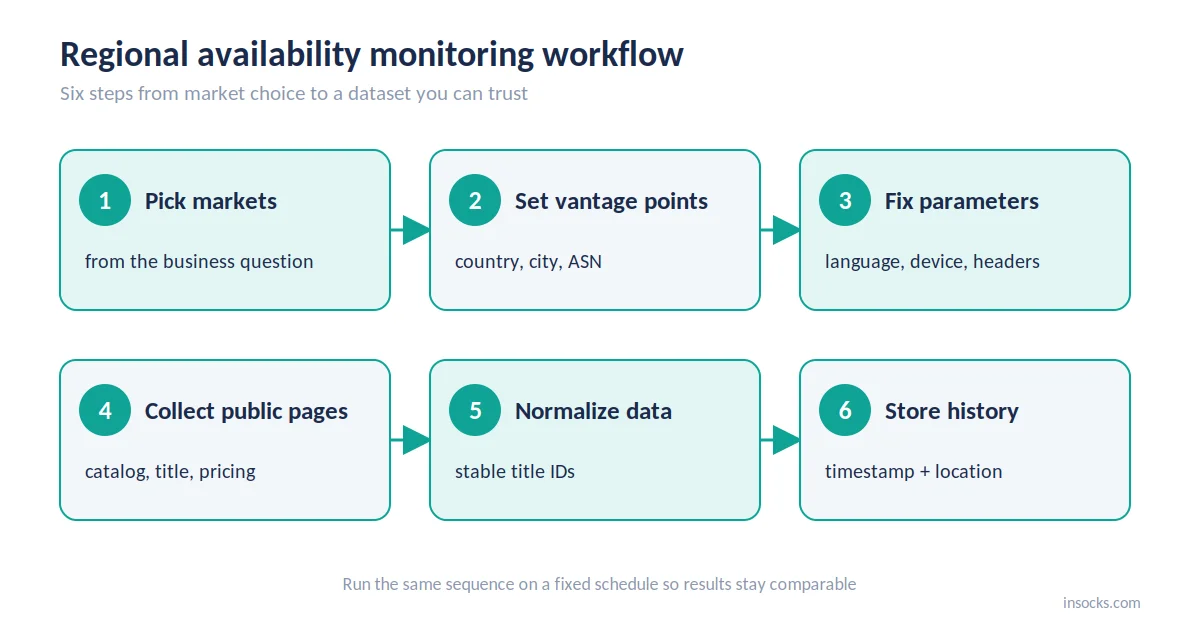
From market selection to stored history
How to choose vantage points
In streaming catalog monitoring, a vantage point is the location and network a request comes from. Country-level geo targeting covers presence checks, while city-level targeting matters when offers or bundles differ by metro area.
Check the ASN as well. A consumer ISP in the target market gives the most representative view, and two different ISPs help you spot provider-specific differences. Two or three vantage points per market are a practical start.
"One vantage point tells you what a page showed once. Two or three that agree tell you what the market shows."
— Insocks Technical Team
How to keep results comparable across regions
Geo targeted monitoring gives clean comparisons only when location is the one variable that changes. Hold every other setting constant and use a sticky session for each check.
| Parameter | Why it matters |
|---|---|
| Language and headers | Can switch the catalog view |
| Device type | Mobile and desktop listings can differ |
| Time zone | Changes what counts as "new today" |
| Time of measurement | Catalogs update at different hours |
| Page version | A/B tests change what a request sees |
💡 Store these parameters next to every result. When two runs disagree, the stored settings usually explain why within minutes.
How to validate the data you collect
Content availability monitoring is only as reliable as its validation step. A single redirect to the wrong market can distort a whole comparison.
| What to check | Expected result |
|---|---|
| Geo match | Page reflects the intended market |
| Redirects | No jump to another regional site |
| Completeness | Full listing, no partial content |
| Repeat measurement | Second check confirms the first |
When two vantage points in one market disagree, rerun both within the hour. If the difference persists, record it as a real local variation rather than an error.
Example: a distributor's release check
A US distributor licensed a documentary to one platform in six markets with staggered dates. Daily checks from two residential vantage points per market showed the title live in five. The sixth had a plan page but no listing, and the rights team raised it with the platform two days before a marketing push.
Request pacing and session hygiene
Request pacing keeps content availability monitoring light on the platform and consistent for your data. Low, steady volume within published limits produces cleaner results.
- ✅ Space requests out and follow published rate limits.
- ✅ Use one sticky session per check, then release it.
- ❌ Retrying instantly after an error.
- ❌ Requesting the same page many times a minute.
💡 Collect only the pages your metrics need. Fewer requests mean lower cost, less load on the platform and faster validation. When the business question allows, schedule runs outside the platform's peak evening hours.
Common mistakes in availability monitoring
Streaming catalog monitoring usually goes wrong in the same few ways, and each one quietly skews the data.
| Mistake | Impact | Fix |
|---|---|---|
| ❌ One vantage point per region | Local differences go unnoticed | Use two or three per market |
| ❌ IP change during a check | Two locations mixed in one result | Hold a sticky session |
| ❌ Comparing different days | Normal churn looks like a trend | Compare the same time window |
| ❌ Ignoring locale settings | Wrong catalog version loads | Fix language per market |
Legal and ethical notes (USA)
Keep monitoring to publicly available pages and within each platform's terms. Anything behind a login or paywall is out of scope. Terms differ between services, so review them before adding a new platform to the program.
- ✅ Collect only publicly accessible catalog and pricing pages.
- ✅ Respect robots.txt and each platform's terms of service.
- ❌ Bypassing paywalls, DRM or other technical protection measures.
- ❌ Using other people's accounts or credentials.
When you use proxies for media research, you confirm that you apply them within current US law. Insocks provides its service for lawful use in the United States; for specific cases, check with legal counsel.
Choosing proxies for regional monitoring
Streaming catalog monitoring works best with a provider that offers wide consumer-IP coverage, precise targeting and stable sessions. Insocks provides residential and ISP pools with city-level targeting and ASN selection, plus fraud-score and blacklist checks on its IPs.
| Feature | Benefit |
|---|---|
| Wide residential coverage | More markets to compare |
| City and ASN targeting | Vantage points that match real users |
| Sticky sessions | One IP for the length of each check |
| IP quality checks | Fewer failed requests to rerun |
| Free demo | Targeting tested on your own workflow |
👉 Try demo proxies on a few markets, then register for full access or buy residential proxies when the data holds up.
Key takeaways
- Streaming availability monitoring uses public catalog, title and pricing pages only.
- Regional content availability follows licensing windows, so dated history beats snapshots.
- Residential IPs are the default for regional checks; ISP IPs suit long runs.
- Fix every parameter except location and use sticky sessions.
- Validate geo match and repeat checks before data reaches a report.
Frequently asked questions
What is streaming availability monitoring?
It's the scheduled tracking of which titles a streaming service lists in each country and when that changes.
Why does the same title appear in one country and not another?
Rights are licensed by territory, so a platform shows a title only where it holds those rights.
Which proxy type is best for regional catalog checks?
Residential proxies, because their IPs match real consumer locations; ISP proxies suit long, fixed sessions.
How many vantage points do I need per market?
Two or three per market is a practical starting point.
How often should availability data be collected?
Daily around launches and expiring titles, weekly for general catalog tracking.
Is regional availability monitoring legal?
Collecting publicly available pages is generally lawful in the US when you follow site terms, but check specific cases with counsel.
More guides are in the Insocks blog.