
SOCKS5 vs WireGuard vs OpenVPN for UDP traffic
What each technology is
SOCKS5 is a proxy protocol, while WireGuard and OpenVPN are VPN protocols. The first routes selected apps; the other two route a whole device through an encrypted tunnel, which is where most proxy vs VPN confusion starts.
- SOCKS5: a session-layer proxy defined in RFC 1928, with optional authentication and no built-in encryption.
- WireGuard: a lean VPN that runs over UDP, often as a kernel space tunnel.
- OpenVPN: a mature TLS-based VPN that runs over UDP or TCP.
WireGuard's implementation fits in under 4,000 lines of code, small enough for a single engineer to review.
— Jason A. Donenfeld, WireGuard paper (NDSS 2017)
How each one handles UDP
SOCKS5 relays UDP only when the provider enables UDP ASSOCIATE. WireGuard always uses UDP as its transport, and OpenVPN offers a UDP mode with TCP as the alternative.
| Tool | UDP handling | Encryption | Scope |
|---|---|---|---|
| SOCKS5 | UDP ASSOCIATE, if enabled | None | Per app |
| WireGuard | UDP transport only | ChaCha20-Poly1305 | Whole device |
| OpenVPN | UDP or TCP mode | AES-GCM or ChaCha20-Poly1305 | Whole device |
OpenVPN UDP mode is usually faster than TCP mode, since it avoids stacking TCP retransmissions on top of each other.
SOCKS5 has one quirk worth knowing: fragmentation of relayed datagrams is optional in the spec, and most servers drop fragmented packets. Apps that keep UDP payloads small, as VoIP and games do, rarely notice.
Application-level proxy vs system-wide tunnel
A proxy carries traffic only from apps configured to use it, while a tunnel carries everything the system routes into it. That scope difference drives most SOCKS5 vs VPN decisions.
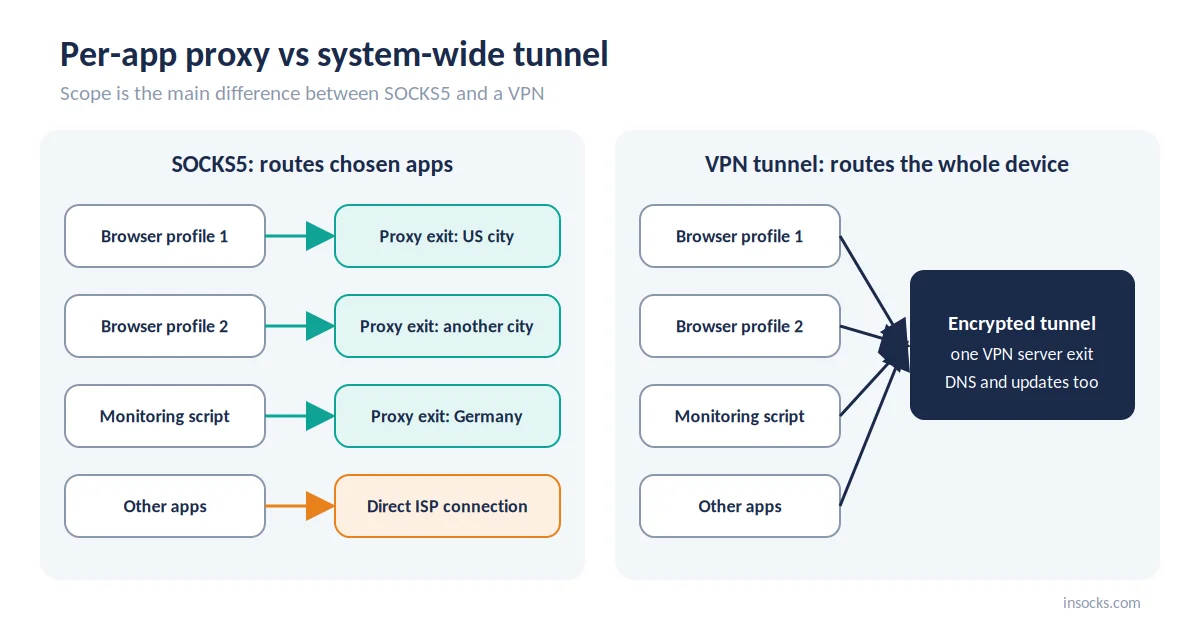
A proxy routes chosen apps; a tunnel routes the whole device
With a proxy, one browser profile can use a US exit while the rest of the system stays on the local connection. With a tunnel, background services, updates and DNS go through it too. Apps need SOCKS5 support to use a proxy, but they don't need to know about a VPN at all.
💡 If only one app needs a different exit, a proxy avoids rerouting the whole machine.
Side-by-side comparison
The core SOCKS5 vs WireGuard difference is scope: per-app routing without encryption versus an encrypted tunnel for the whole device. The table covers the rest.
| Criterion | SOCKS5 | WireGuard | OpenVPN |
|---|---|---|---|
| OSI layer | Session (L5) | Network (L3) | Network (L3), L2 in TAP mode |
| UDP | Via UDP ASSOCIATE | Native, UDP only | UDP or TCP |
| Encryption | None built in | ChaCha20-Poly1305 | AES-GCM or ChaCha20 |
| Per-app routing | Yes | Only with split tunneling | Only with split tunneling |
| Exit IP type | Residential, mobile, ISP or datacenter | Usually datacenter | Usually datacenter |
| Geo selection | Country, city, sometimes ASN | VPN server list | VPN server list |
| Overhead | Low | Low | Moderate to high |
| Setup complexity | Low, per app | Low, one config | Medium, many options |
Treat the overhead row as relative: real numbers depend on hardware, cipher and network path.
Speed and latency
WireGuard is usually the fastest of the three on networks that allow UDP. Its short handshake and lean cryptography keep encryption overhead and handshake latency low.
OpenVPN runs in user space with a heavier TLS handshake, and in TCP mode packet loss triggers retransmissions at two levels. A WireGuard vs OpenVPN test on the same lossy link usually favors WireGuard. SOCKS5 adds no encryption cost, so its speed depends mostly on the proxy server's distance and load.
Per-packet overhead matters for small UDP packets too. WireGuard adds 60 bytes per packet over IPv4 and 80 over IPv6, which is why its default MTU is 1420. A SOCKS5 UDP header for an IPv4 destination takes 10 bytes, and OpenVPN overhead varies with cipher and settings.
Encryption and privacy
SOCKS5 does not encrypt traffic, while WireGuard and OpenVPN do. A proxy changes the exit IP; a tunnel also hides the contents from the local network. Most web traffic already uses HTTPS, so the practical gap is smaller than it looks, but DNS queries and older protocols still travel in the open without a tunnel.
- ✅ WireGuard and OpenVPN encrypt everything inside the tunnel.
- ✅ HTTPS through a SOCKS5 proxy stays protected by TLS.
- ❌ Plain SOCKS5 leaves unencrypted protocols readable along the path.
- ❌ SOCKS5 username and password authentication is sent in clear text.
On the privacy side, the SOCKS5 vs VPN rule is simple: use a tunnel whenever you don't trust the local network.
Per-app routing and multiple exits
Proxies make it easy to run several exits at once from one machine. With per app routing, each browser profile, script or tool can use its own SOCKS5 endpoint.
A QA team can open a US page from New York in one profile and from Texas in another while a monitoring script uses a German exit. Doing the same with WireGuard takes several tunnels and routing rules, so on this point SOCKS5 vs WireGuard clearly favors the proxy. Each endpoint can also be sticky or rotating, so a long QA session keeps its IP while a monitoring job refreshes it.
Exit IP quality and geo targeting
Proxy pools offer more exit IP types and finer geo targeting than VPN server lists. VPN exits are usually datacenter IPs in selected cities.
| Option | IP type | Targeting depth |
|---|---|---|
| SOCKS5 pool | Residential, mobile, ISP, datacenter | Country, city, sometimes ASN |
| WireGuard VPN | Usually datacenter | Country or city server |
| OpenVPN VPN | Usually datacenter | Country or city server |
VPN exits are shared by many customers of the same service, so their reputation reflects everyone's activity. Dedicated proxy IPs give a more predictable history. For localized QA and ad verification, the exit type matters as much as the location. Compare residential proxy and ISP proxy options for these tasks.
When to choose SOCKS5
Choose SOCKS5 when specific apps need specific exits and encryption is already handled, for example by HTTPS. Setup is per app: most browsers, scrapers and SDKs accept a socks5h:// address with a login and password. In most SOCKS5 vs WireGuard decisions, the proxy wins once exit type and location matter more than tunnel encryption.
- Per-app or per-profile routing
- Many exit locations in parallel
- Geo tasks: localized QA, SERP checks, ad verification
- UDP apps, when the provider supports UDP ASSOCIATE
Example: regional ad QA
A US agency checks how display ads render in five states. Each browser profile uses its own SOCKS5 proxy with a city-level exit, while the team's VPN stays on for internal tools. The review takes minutes instead of an afternoon of switching tunnels.
When to choose WireGuard
Choose WireGuard when the whole device needs encryption with minimal overhead and the network allows UDP.
- All device traffic in one tunnel
- Low CPU and battery use on phones
- Lowest latency of the VPN options
WireGuard gives the device one exit at a time. If different apps need different locations, add a proxy on top instead of juggling several tunnels.
When to choose OpenVPN
Choose OpenVPN when UDP isn't available or when you need broad client compatibility. In a WireGuard vs OpenVPN choice, this is where OpenVPN keeps its place.
- TCP fallback on networks where only TCP is permitted
- Existing corporate deployments and older clients
- Detailed options such as TAP mode and certificate setups
OpenVPN UDP remains the faster mode wherever the network allows it.
Can you combine them
Yes, and you don't always have to settle SOCKS5 vs VPN. A common setup keeps a VPN on for the device and points one app at a SOCKS5 proxy for its own exit.
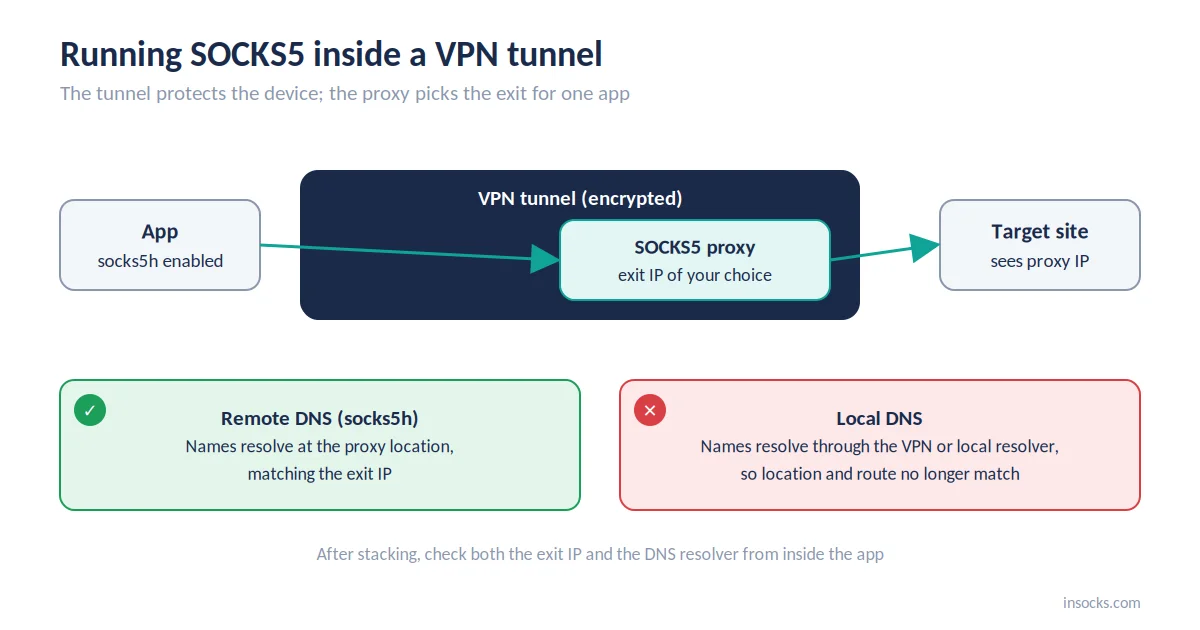
The tunnel protects the device; the proxy picks the exit for one app
The app's traffic travels through the tunnel to the proxy, then leaves from the proxy's IP. For UDP tunneling in this setup, the proxy still needs UDP ASSOCIATE. The usual catch is DNS: if the app resolves names locally, lookups follow a different route, so enable socks5h or the app's remote DNS option.
💡 After stacking, check both the exit IP and the DNS resolver from inside the app.
Common mistakes when choosing
Most mistakes come from expecting one tool to do another's job. The classic SOCKS5 vs WireGuard mix-up is expecting a proxy to encrypt traffic. Others only show up when a specific app fails without a clear error.
| Mistake | Impact | Fix |
|---|---|---|
| ❌ Expecting SOCKS5 to encrypt | Plain protocols stay readable | Use HTTPS or add a tunnel |
| ❌ Using UDP without checking support | UDP apps fail silently | Test UDP ASSOCIATE first |
| ❌ Leaving OpenVPN on TCP by default | Extra latency under packet loss | Use UDP mode where allowed |
| ❌ Resolving DNS locally | Lookups bypass the chosen route | Enable remote DNS or socks5h |
Why SOCKS5 with real UDP support fits proxy tasks
A SOCKS5 proxy with working UDP ASSOCIATE keeps the flexibility of a proxy and adds the UDP path real-time apps need. With that in place, SOCKS5 vs WireGuard becomes a question of task, not of missing features. Insocks supports SOCKS5 UDP on all proxy types except mobile.
| Feature | Benefit |
|---|---|
| Working UDP ASSOCIATE | VoIP, gaming and WebRTC through the proxy |
| Per-app assignment | Different exits for different tools |
| Residential, ISP and datacenter pools | Exit type matched to the task |
| City and ASN targeting | Precise geo checks |
| Remote DNS | DNS follows the proxy route |
👉 Test UDP on a live pool with demo proxies, then register for full access or buy a UDP proxy.
Key takeaways
- SOCKS5 routes chosen apps; WireGuard and OpenVPN tunnel the whole device.
- SOCKS5 has no built-in encryption; both VPNs encrypt everything in the tunnel.
- WireGuard vs OpenVPN: WireGuard wins on speed, OpenVPN on TCP fallback and flexibility.
- For UDP through a proxy, confirm UDP ASSOCIATE support first.
- A proxy inside a VPN works well when DNS follows the proxy.
Frequently asked questions
Is SOCKS5 faster than WireGuard?
Often, because SOCKS5 skips encryption, though server distance and load matter more.
Does SOCKS5 encrypt traffic?
No, only the app's own protocol, such as HTTPS, encrypts data sent through SOCKS5.
Does WireGuard work over TCP?
Not natively; WireGuard uses UDP only.
Which is better for UDP traffic, a proxy or a VPN?
A VPN if you need all device traffic encrypted; a SOCKS5 proxy with UDP ASSOCIATE if you need per-app exits and geo targeting.
Can I run SOCKS5 and a VPN at the same time?
Yes, many setups run a SOCKS5 proxy inside an active VPN tunnel.
Which option gives better geo targeting?
SOCKS5 proxy pools, which often target by city and ASN instead of a fixed server list.
Using proxies, you confirm that you apply them within current US law. Insocks is built for lawful use in the United States. More guides are in the Insocks blog.